
Predicting the future of any field that is in the middle of significant technological change is a humbling exercise. The history of technology in healthcare is littered with confident predictions that proved wrong in their timing, their direction, or both. So the future of pathology is best approached with appropriate epistemic modesty, acknowledging what seems clearly directional while being honest about what remains genuinely uncertain.
What seems directional: pathology is moving toward a more computational, more integrated, more data rich discipline. The three pillars of this shift, artificial intelligence, laboratory information systems, and digital imaging, are already established enough to call them present tense rather than future tense. What is changing is the degree of integration between them, the sophistication of the AI tools involved, and the breadth of the diagnostic tasks they are being applied to.
The Current State of AI in Pathology
The current state of AI in pathology is best described as narrow but promising. The AI tools that have reached clinical deployment are mostly focused on specific, well defined tasks:
- Detecting and grading prostate cancer on core needle biopsy
- Identifying and counting mitoses in breast cancer slides
- Screening cervical cytology for abnormal cells
- Assessing tumor infiltrating lymphocytes in breast cancer
- Predicting molecular subtypes from morphological features
These are high value tasks, and the tools perform well for their intended purposes. But the vision that pathologists and AI researchers are working toward, including systems that can assist with a much broader range of diagnostic questions and integrate multiple data types, is still in development.
Foundation Models: The Next Generation
The next generation of AI tools for pathology will likely be characterized by greater generalization. Foundation models, large AI models trained on broad datasets that can be fine tuned for specific tasks, have shown remarkable versatility in other domains, and there is active research applying this approach to pathology.
The idea is that a model trained on millions of pathology images from diverse sources can develop representations of tissue morphology that are broadly useful, and then be adapted for specific diagnostic questions with relatively small amounts of task specific training data.
Why Digital Imaging Is the Foundation
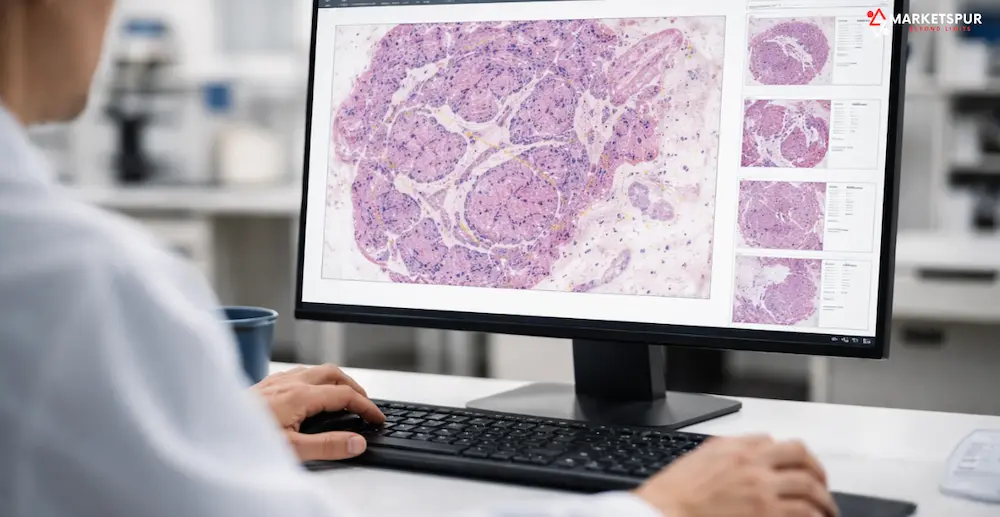
Digital imaging is the foundational infrastructure that makes any of this possible. You cannot apply AI analysis to glass slides. You need digital whole slide images. And the quality of the imaging matters because AI algorithms trained on high resolution images perform differently on lower resolution images, and variations in staining quality, tissue preparation, and scanner characteristics can all affect AI performance. The standardization of digital pathology workflows is a prerequisite for reliable AI assisted analysis, not something that can be figured out after the fact.
The LIS as Connective Tissue
The LIS platform is what connects the imaging and AI layers to the rest of the workflow. An AI analysis result that exists only in a separate system does not automatically enter the case record, does not feed into the report, and does not integrate with the broader clinical information about the patient. The value of AI assistance is multiplied when it is embedded in the workflow, when the pathologist sees AI flags within the same interface they are using to review the case, and when the AI analysis results are captured as structured data in the LIS. Laboratory information systems that support AI and digital pathology bring tremendous value as more and more labs go digital.
Molecular Pathology: A Converging Frontier
Molecular pathology is another frontier reshaping the discipline. Next generation sequencing, liquid biopsy, and companion diagnostics for targeted therapies are generating diagnostic information that was not available a decade ago. That information needs to be integrated with morphological diagnosis, clinical context, and treatment guidelines in a way that is meaningful to the oncologists and other clinicians making treatment decisions. The LIS platforms of the future will need to handle this integration naturally.
Regulatory and Training Considerations
The regulatory and reimbursement environment for AI assisted pathology is still taking shape. The FDA has approved or cleared a growing number of AI tools for pathology, but the regulatory pathways and standards for evaluating these tools continue to evolve. Training the next generation of pathologists in this digital environment is a challenge that medical education is actively grappling with.
Pathologists who trained primarily on glass slides need continuing education to work effectively with digital imaging tools and AI assistance. Medical students and pathology residents entering training now will need to develop competencies around digital pathology from the start, including how to evaluate AI recommendations critically rather than accepting them uncritically.
The integration of AI, LIS software, and digital imaging in pathology is not a distant future. It is happening now, in leading labs, and it is becoming the direction the entire field is moving.
The labs that are building this integrated capability today are not just improving their current operations. They are developing the expertise, the infrastructure, and the institutional knowledge to remain competitive as these tools become more capable and more widespread.