
The CPA course is beneficial for professionals in the field of accounting and finance who seek to develop expertise in areas such as taxation, auditing, business proposals, and financial statement preparation. The course follows a structured approach to ensure that candidates get technical and conceptual knowledge in practical situations. With a flexible exam system and an evolving curriculum, the CPA exam aligns with industry demands, making it valuable for professionals seeking global career opportunities.
Understanding how the exam works plays a big role in studying. CPA full form (Certified Public Accountant) examinations are divided into different sections. Each section assesses different skills through different types of questions and marking systems. Multiple choice and simulation tasks are included in the exam. It assesses your conceptual as well as analytical abilities. Knowledge about the test pattern and marking scheme will be helpful for candidates to manage their time effectively during preparation.
Streamline CPA Course Prep: Insights into Exam Structure, Syllabus & Other Criteria
1. Four Core Exam Sections
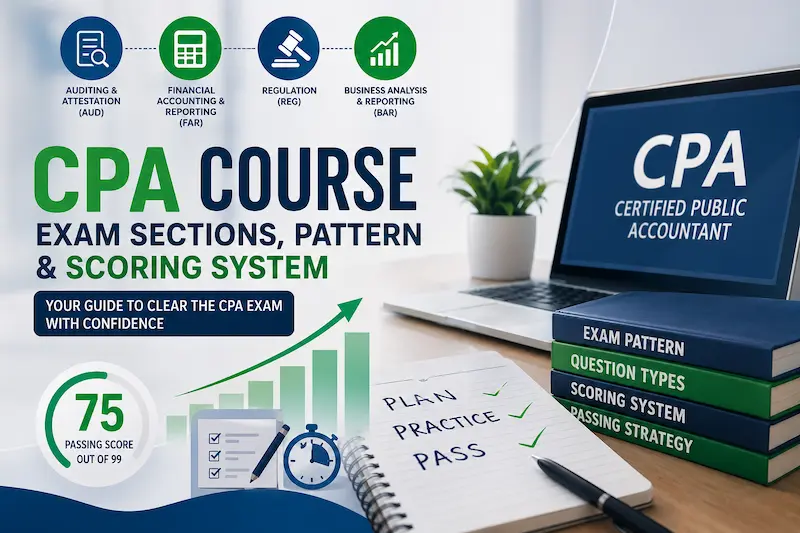
The four main sections of the CPA course exam are Auditing & Attestation (AUD), Financial Accounting & Reporting (FAR), Regulation (REG), and Business Analysis & Reporting (BAR), or another section based on the applicant’s selected path. These section exams are formulated so that they cover various aspects of accountancy skills.
FAR is considered the most extensive, covering financial reporting frameworks, while AUD focuses on auditing processes and ethics. REG focuses on taxation and legal regulations, and the discipline section enables candidates to specialise based on their career objectives, making the structure flexible and broad.
2. Flexible Exam Structure and Discipline Choice
The CPA full form (Certified Public Accountant) Evolution allowed for some freedom because applicants could choose their discipline sections after taking their core sections. This allows candidates to align their exam strategy with their career interests, such as business analysis, tax compliance, or information systems.
This approach makes sure all candidates have strong fundamental knowledge through core sections while gaining deeper expertise in a specific area. It improves career relevance and enables professionals to stand out in the competitive job markets.
3. Exam Pattern and Question Types
Each CPA full form (Certified Public Accountant) exam includes a combination of Multiple Choice Questions (MCQs) and Task-Based Simulations (TBS). Some sections include written communication tasks, especially in the areas of evaluating professional communication skills.
The simulations specifically assess how well students can apply concepts to real life situations instead of testing their theoretical knowledge. Through assessments, those who become CPAs and finance managers would be able to acquire the skills they need to perform their job functions in future.
4. Duration and Time Allocation
The CPA examination comprises four sections, and each section is 4 hours long. Thus, managing one’s time well during the CPA examination becomes very important for success. Candidates should know how to manage their time when answering MCQs and simulations in the test, ensuring that they have sufficient time to answer all questions.
Time management during the test will be vital in determining the performance of candidates. These include being able to complete MCQs quickly and spending sufficient time on simulations.
5. Scoring System and Weightage
The CPA course exams are scored on a scale of 0 to 99, with a minimum passing score of 75 for each section. The scoring system isn’t completely percentage-based but it is scaled as per the difficulty levels of questions.
MCQs and TBS carry different weightage, depending on the exam section. For example, MCQs will contribute about 50%, while the rest will be simulations, making it clear on theoretical understanding and practical skills.
6. Adaptive Testing Mechanism
The CPA course examination makes use of the multi-stage adaptive testing system for MCQs. This means that the difficulty level of the second testlet depends on the candidate’s performance in the first testlet.
If a candidate performs well initially, they receive a more difficult set of questions next, which can positively impact your scoring potential. This system ensures a more accurate evaluation of a candidate’s ability level.
7. Passing Strategy and Section Independence
Each section of the CPA exam is independent, which means candidates can take them in any order and do not need to pass all sections at once. But when the candidate passes the initial section, he/she will have to finish the rest of the sections within a specified timeframe (18 to 30 months) from one jurisdiction to another.
This provides flexibility for working professionals managing both jobs and exam preparation requires some planning from candidates on how to pass all sections within the set time frame.
Conclusion
It is critical to understand the structure of the CPA course and exams and the scoring system to have a clear guide in preparing for the exams. Through the proper balancing of time management, adequate knowledge of the concept, and consistent practice, candidates will find it easier to pass all parts of the CPA examination and score full marks. Begin your CPA preparation right now by contacting Zell Education!
FAQs
1. How many sections are there in the CPA examination?
The CPA exam includes four sections, AUD, FAR, REG and other discipline sections.
2. What are the passing criteria for CPA?
You must score at least 75 in each of four exam sections within a window of 18 to 30 months.
3. Is there an order in which I can give the CPA exams?
Candidates may give the sections in any sequence according to their preparedness.