
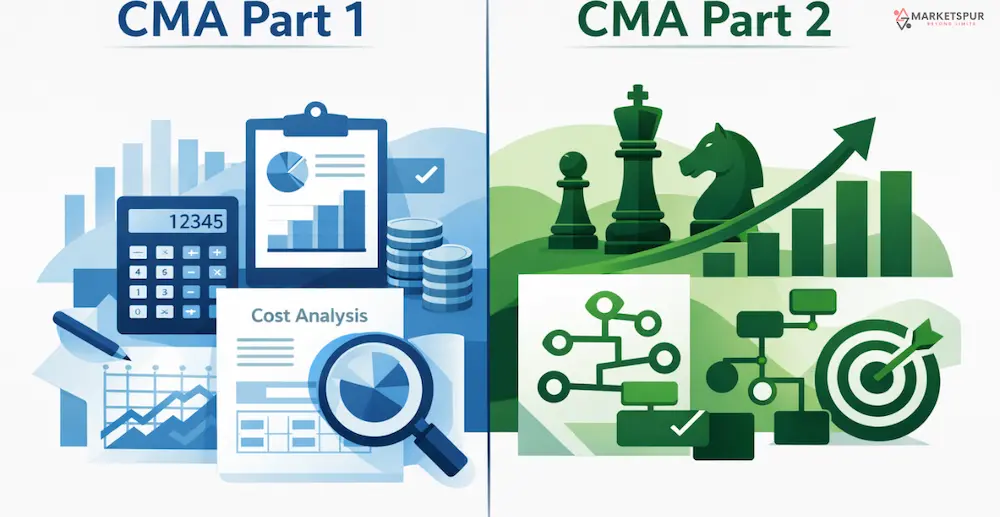
Coming to the choice between CMA Part 1 and Part 2, the candidates are left with a dilemma of which one is easier and how their study plan should be different. Both parts are equally difficult in their own ways, but this is different from person to person based on their background and what they are best at. Part 1 focuses on financial planning, analysis, and performance, which can be more technical and calculation intensive, especially if you are not familiar with management accounting concepts.
Whereas Part 2 is more about strategic financial management. This is less computationally intensive and more concept driven and theory based. It is important to note these differences from the start and plan your study process accordingly to ensure a smooth Certified Management Accountant course experience.
CMA Course: Streamline Part 1 & Part 2 Exam Preparation
1. Conceptual Foundation vs Application Based Thinking
Part 1 is relatively easier since it deals with developing fundamental concepts in financial planning, internal controls, cost management, and performance management. The syllabus provides a structured approach that helps students with accounting or commerce backgrounds navigate their studies more effectively. Most questions are designed to assess understanding of concepts and calculations in standard formats, reducing the likelihood of confusion during the exam.
CMA Part 2 places heavy emphasis on application and judgment. Topics such as corporate finance, financial statement analysis and decision analysis need you to interpret data and make strategic decisions. Preparation for the Part 2 exam must go beyond learning formulas; you need to determine why decisions are made and how financial data influences business strategy.
2. Quantitative Comfort vs Analytical Interpretation
Calculations in Part 1 of the Certified Management Accountant course are simple and repetitive, particularly in budgeting, costing methods, and variance analysis. After sufficient practice with numerical problems, certain patterns start to emerge that help you perform well on the exam. This predictability is why candidates feel more confident.
Part 2 includes fewer calculations but deeper analysis! You will face scenario based questions where numbers support broader financial decisions. The process of effective preparation requires two components: case question practice, reading speed improvement, and information selection training.
3. Syllabus Familiarity vs Strategic Depth
The curriculum for Part 1 overlaps with that of undergraduate accounting and finance programs. Areas such as financial statement analysis, internal control, and cost accounting are quite familiar, which will help you learn. You can prepare well for the exam by following a proper study plan and emphasizing problem solving practice.
Moreover, CMA Part 2 also has areas of strategic finance that may not be familiar to most candidates. Areas such as risk management, professional ethics, and investment decisions require a broader perspective on business. Preparation must involve linking concepts across topics and understanding how financial decisions affect a long term company’s performance.
4. Exam Confidence vs Time Management Challenge
As there are fewer subjective questions, candidates feel more confident during Part 1 exams. Once you have enough practice tests, you can easily forecast your performance. Time management becomes easy once you are familiar with the typical question format.
Part 2 of the Certified Management Accountant certification is tougher in terms of time management. The questions are longer and imperative, requiring careful reading. To prepare for this, you should practice taking full length mock tests under timed conditions and learn to eliminate incorrect options to save time in critical scenarios.
5. Preparation Approach: Structured Practice vs Integrated Learning
Preparing for the Part 1 exams can be done step by step, beginning with concepts. Move on to numerical problems, then finish with revision and mocks. Consistent daily practice and formula revision play a major role in success, making this part manageable even for first time Certified Management Accountant candidates.
For Part 2 exams, preparation must be more integrated. You must combine theory with real world examples, frequent revision of interconnected topics and case studies. The key is to think like a finance manager rather than a student, which is essential for success in the more demanding Part 2 examination.
6. Formula Dependency vs Decision Making Skills
In Part 1 of the Certified Management Accountant course, formulas play an essential role. Whether it is variances, breakeven analysis or cost allocations, having formulas at your fingertips boosts speed and accuracy. This makes prep mechanical practice enough problems, and performance enhances steadily.
Part 2 minimises reliance on formulas and places greater emphasis on judgment. You are expected to assess options, evaluate risks and select the most financially sound decision. Preparation must focus on understanding the assumptions behind models and on learning to justify decisions using financial logic.
Conclusion
CMA Part 1 feels easier since it covers theory. Part 2 can be tougher because it tests how well you apply knowledge and break down situations. What seems simpler depends on your background, your comfort with numbers, and the areas you excel in. If you make a good study plan, get a solid grasp of the concepts, and practice enough, you can handle both parts just fine. Proper prep work turns difficulty into momentum and gets you exam ready.
FAQs
1. Which CMA part is easier: Part 1 or Part 2?
Part 1 is generally considered easier as it focuses on concepts rather than calculations.
2. Is work experience helpful for Certified Management Accountant Part 2?
Yes, practical finance or accounting experience makes the Part 2 exam easier to relate to.
3. Which CMA part is more scoring?
Part 1 scores higher when concepts are clear and well revised.