
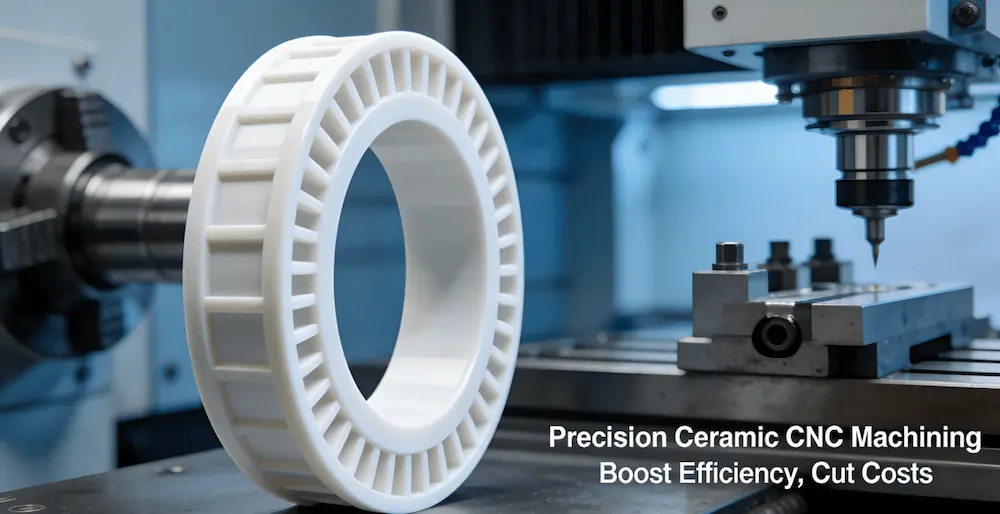
Advanced Ceramic CNC machining enables high precision manufacturing for industrial equipment, significantly boosting efficiency and reducing operational costs.
- Introduction
- What is the core process of ceramic CNC machining and how does it improve industrial equipment manufacturing efficiency?
- How to optimize ceramic CNC machining through parameter settings to avoid common errors?
- What are the practical techniques for ceramic CNC machining that can be applied to product development?
- How does ceramic CNC machining solve the deep seated problems of low manufacturing efficiency?
- How will ceramic CNC machining evolve in the future of industrial equipment manufacturing?
- Conclusion
- Author Biography
- FAQs
Introduction
In the competitive field of industrial equipment manufacturing, efficiency is directly linked to profitability and market reputation. Many manufacturers face a persistent challenge: processing inefficiency leads to cost overruns and project delays, severely impacting overall profit margins. The core issue often lies in the fact that traditional methods struggle to process high hardness materials like ceramics, resulting in rapid tool wear and inconsistent quality.
To address this fundamental problem, ceramic CNC machining technology offers a robust solution. By optimizing processes and parameters, it enables efficient, precise, and reliable manufacturing. The following sections will provide a step by step analysis of how to apply these solutions effectively.
What is the core process of ceramic CNC machining and how does it improve industrial equipment manufacturing efficiency?
Ceramic CNC machining is not simple “cutting” but a rigorous, synergistic system of precision manufacturing. The standardization and optimization of its Core processes of ceramic CNC machining are key to enhancing Industrial Equipment Manufacturing Efficiency. A typical process involves several critical stages, each designed to minimize material waste while ensuring the performance and accuracy of the final component.
Stage One: Strategic Roughing
The goal of roughing is to remove the bulk of excess material quickly and safely, preparing the blank for finishing. This phase focuses on selecting impact resistant specialized tools and employing conservative cutting parameters to avoid introducing excessive stress or micro cracks into the material. An efficient roughing strategy significantly shortens the overall machining cycle, laying a solid foundation for subsequent operations.
Stage Two: Precision Finishing
This is the core stage that determines the final dimensional accuracy and surface quality of the part. Finishing utilizes higher spindle speeds, lower feed rates, and micron level cutting depths to progressively achieve the tolerances and finish specified in the design. This stage demands extremely high dynamic accuracy from the machine tool, sharpness from the tool, and efficiency from the cooling system, making it where the true value of the core process is realized.
Stage Three: Comprehensive Quality Inspection
Quality is the ultimate guarantee of efficiency. A meticulous inspection process ensures every outgoing part meets standards, preventing larger losses from failures during assembly or use.
- Dimensional and Geometric Verification:
Using high precision equipment like Coordinate Measuring Machines (CMM) to rigorously validate all critical dimensions and geometric tolerances, especially for components requiring precise fits in Industrial Equipment. - Surface Integrity Analysis:
Microscopes or profilometers are used to inspect machined surfaces for defects like cracks or chipping, which is critical for the reliability of ceramic parts in high pressure, high wear environments. - Performance Conformity Testing:
Depending on the part’s application, additional tests for hardness, density, or dielectric properties may be conducted.
Adhering to international quality management systems like ISO 9001 ensures the reliability and consistency of the entire ceramic CNC machining process, fundamentally improving yield and production efficiency.
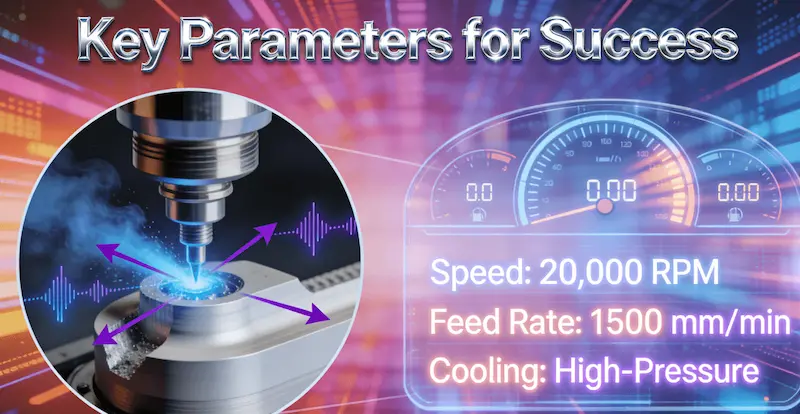
Optimizing parameters like speed, feed rate, and cooling is critical to preventing tool wear and achieving high quality results in ceramic machining.
How to optimize ceramic CNC machining through parameter settings to avoid common errors?
Parameter settings for ceramic CNC machining act as the critical bridge between theoretical process and high quality output. Their scientific determination directly dictates the success of the operation and its efficiency. Incorrect parameters are a common source of premature tool wear, part fracturing, and even machine tool damage.
Optimization hinges on balancing the “material removal rate” with “machining stability.” The cutting speed must be high enough to avoid excessive grinding but not so high as to cause thermal cracks. The feed rate needs to be moderate to ensure a steady cutting force, while the depth of cut must be finely set according to the specific ceramic type and tool strength, often adopting a “light depth, fast feed” strategy.
Furthermore, efficient and precisely directed coolant is indispensable for carrying away heat and preventing thermal damage. These settings are not static; they require dynamic adjustment based on material batch, tool condition, and machine capability. Their collective goal is to adhere to stringent standards like ASME Y14.5, ensuring interchangeability and functionality. For instance, a precision pump valve manufacturer optimized the machining parameters for its alumina ceramic seal rings, reducing single piece processing time by 20% and increasing tool life by 35%, a direct demonstration of effective Productivity Solutions. Systematic parameter management and process database accumulation allow businesses to maximize the potential of their CNC machining equipment.
What are the practical techniques for ceramic CNC machining that can be applied to product development?
Mastering Practical techniques for ceramic CNC machining during rapid Product Development can significantly reduce trial and error iterations and accelerate time to market. These techniques are applied throughout the entire journey from design to finished part.
Design for Manufacturing (DFM) Optimization
Considering manufacturability during the design phase is crucial. For example, avoiding sharp internal corners (recommending radius transitions) and setting realistic tolerances (excessively tight tolerances drastically increase cost and time) can simplify the subsequent Ceramic machining challenges and improve success rates from the start.
Intelligent Tooling and Path Planning
Selecting dedicated diamond or CBN coated tools for different ceramic materials (e.g., alumina, silicon nitride, zirconia) is paramount. Simultaneously, using CAM software for intelligent toolpath planning, such as helical interpolation and trochoidal milling, helps maintain constant cutting forces, reduces impact on the brittle ceramic material, and yields better surface finishes while protecting the tool.
Process Monitoring and Stability Control
A stable machining environment is a prerequisite for consistent quality. This requires monitoring and controlling several variables.
- Vibration Monitoring and Damping:
Using accelerometers to monitor machine vibration and adjusting parameters or adding damping to suppress chatter is fundamental to ensuring surface finish and dimensional accuracy. - Temperature Consistency Management:
Ensuring the stability of the machine tool, workpiece, and ambient temperature is critical, especially for high precision parts where thermal deformation must be minimized. - In Process Measurement and Compensation:
Utilizing machine probes for on machine inspection of critical dimensions and real time tool compensation enables “machining inspection compensation” closed loop manufacturing, greatly improving first pass success rate and batch consistency.
Partnering with a manufacturer which holds ISO 14001 certification, not only guarantees the professional application of these techniques but also ensures the environmental sustainability of the entire process, adding green value to product development. Their comprehensive CNC machining services cover all these aspects.
How does ceramic CNC machining solve the deep seated problems of low manufacturing efficiency?
The root cause of low efficiency in industrial equipment manufacturing often lies in the inability to effectively process advanced materials. The hard and brittle nature of ceramics leads to low yield rates, lengthy auxiliary times (e.g., frequent tool changes, setup adjustments), and significant manual post processing in traditional methods. Ceramic CNC machining addresses these deep seated issues through a systematic approach.
Firstly, it directly overcomes the machining challenges posed by material brittleness through rigid machine tools, specialized tooling, and precise cooling systems, enabling stable and reliable material removal rates. Secondly, the essence of CNC machining is automation and digitization. Pre programmed instructions allow complex operations to be performed continuously and repetitively, freeing skilled operators from manual tasks to focus on process supervision and optimization, thereby increasing overall equipment effectiveness (OEE) and output per capita.
Most importantly, it introduces predictability and plannability to Manufacturing Efficiency. Accurate machining times, predictable tool life, and a high first pass success rate make production scheduling more reliable, significantly reducing the project delays caused by quality fluctuations and rework. This enhancement of determinism is the core of the Productivity Solutions sought by modern manufacturers transforming production from an “art” into a manageable and optimizable “science.”
How will ceramic CNC machining evolve in the future of industrial equipment manufacturing?
As industrial equipment advances towards higher performance, greater intelligence, and enhanced sustainability, the demand for advanced materials like ceramics will continue to grow, driving the evolution of Ceramic CNC machining technology. Future developments will be closely aligned with the cutting edge needs of Industrial Equipment, deeply integrating digital and intelligent technologies.
The integration of AI and adaptive control will be a key trend. Machine learning algorithms analyzing real time data (sound, vibration, power) during machining can automatically identify tool wear, predict material anomalies, and dynamically adjust cutting parameters for truly “adaptive machining,” maximizing quality consistency and equipment uptime. Secondly, hybrid machining technologies will become more prevalent, such as combining laser assisted heating (to reduce ceramic brittleness) or ultrasonic vibration assistance to further push the boundaries of current material processing limits, opening new design spaces for Product Development
Furthermore, digital twins and virtual commissioning will play a larger role in the process development phase. Simulating and optimizing the entire machining process in a virtual environment allows potential issues like collision, vibration, or overcutting to be predicted and avoided upfront, shifting a significant portion of process validation work earlier and drastically shortening lead times for new products. Businesses must proactively embrace these trends and invest in advanced manufacturing technologies and talent to maintain a competitive edge.
Conclusion
In summary, faced with the manufacturing challenges of high hardness materials, ceramic CNC machining provides a comprehensive solution for industrial equipment manufacturers through standardized core processes, scientific parameter optimization, and evolving cutting edge technologies. It not only directly enhances processing efficiency, stabilizes product quality, and reduces overall costs but is also a critical step towards intelligent and sustainable manufacturing.
For professional ceramic CNC machining solutions to transform your design blueprints into high performance, reliable components, contact our expert team for a customized consultation and quote.
Author Biography
The author is a precision manufacturing expert at LS Manufacturing, with over a decade of experience in advanced materials processing. The expert focuses on helping global industrial equipment manufacturers overcome manufacturing challenges and drive product innovation through innovative CNC technology solutions.
FAQs
Q1: What industrial equipment materials are suitable for ceramic CNC machining?
A: It is suitable for high hardness materials like alumina and zirconia, commonly used in aerospace and medical equipment, to enhance wear resistance and precision, ensuring long term reliability.
Q2: How to evaluate the cost effectiveness of ceramic CNC machining?
A: Cost benefit is assessed by analyzing material savings and extended tool life. Companies can often see a return on investment in the short term; a professional evaluation is recommended to optimize the investment.
Q3: What are the key steps in the core process of ceramic CNC machining?
A: Key steps include blank preparation, roughing, and finishing. Each stage requires strict parameter control to guarantee final dimensional accuracy and surface quality.
Q4: What is the most common error in parameter settings?
A: A common error is using excessively high speeds or depths of cut, which can cause micro cracks. Referencing standards like ASME Y14.5 for calibration helps avoid such costly errors.
Q5: How does ceramic CNC machining support sustainable manufacturing?
A: By maximizing material utilization and near net shape capabilities, it reduces raw material consumption and waste. Automated processing lowers energy use, and professional coolant management minimizes environmental impact, supporting green production goals.