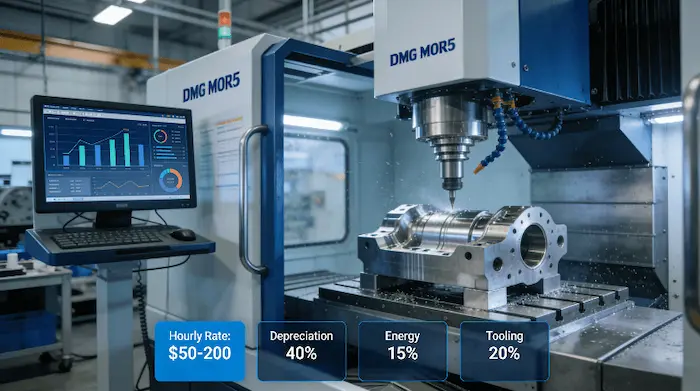
Comprehensive breakdown of CNC machining hourly costs, highlighting how equipment depreciation, energy consumption, and tooling wear contribute to the typical $50 200 per hour rate range.
- Introduction
- What Constitutes the Hourly Rate of a CNC Machine?
- What Are the Key Factors That Influence the Total CNC Machining Cost?
- How to Accurately Calculate the Cost for Your CNC Machining Project?
- 3 Axis vs. 5 Axis Machining: Which Offers Better Cost Efficiency for Your Project?
- Case Study: Achieving 35% Cost Reduction on an Aerospace Bracket
- How Can You Reduce CNC Machining Costs Without Sacrificing Quality?
- Conclusion
- FAQs
Introduction
Manufacturing startups and SMEs often face significant confusion whenreceiving quotes for product development. The single figure of“cost per hour” frequently fails to reflect the total project budget, leading to overspending or hesitation in supplier selection. The core issue is that the final cost is a multi variable equation, dependent on part design, material selection, process routing, and order volume not merely machine runtime. Traditionally, a transparent framework to deconstruct thesecosts has been lacking.
This guide provides a strategic budgeting framework, breaking down the hourly rate into understandable components. By analyzing key cost drivers, comparing the economics of different machining technologies, and presenting a real world cost optimization case study, we equip readers with tools for precise budgeting and smarter decision making. To truly master CNC machining costs, we must first understand the core elements that constitute the hourly rate.
What Constitutes the Hourly Rate of a CNC Machine?
Deconstructing the CNC machining cost per hour transforms it from an opaque figure into a transparent, manageable metric. This hourly rate is not a single expense but a composite of multiple operational factors including machine depreciation, tooling consumption, labor, and facility overhead far exceeding simple electricity calculations.
1. Capital Investment and Depreciation
The most substantial fixed cost is the machine itself. A modern 5 axis machining center represents a significant capital investment. Depreciation, the loss of value over time, is a key factor amortized into the hourly rate. This cost is higher for advanced machinery but is justified by its capabilities.
2. Operational Overheads: Energy, Maintenance, and Software
Ongoing operational costs are critical. Energy consumption can be substantial, especially during high power cutting. Regular preventive maintenance and calibration are non negotiable for maintaining precision, involving costs for labor, parts, and metrology equipment. Furthermore, annual licenses for advanced CAM software are essential for programming complex toolpaths and are factored into the rate.
3. Consumables and Tooling Wear
Cutting tools are consumables. The cost of end mills, drills, and inserts, along with their wear and replacement, is calculated into the hourly price. Machining harder materials like titanium accelerates tool wear, increasing this cost component significantly compared to aluminum.
What Are the Key Factors That Influence the Total CNC Machining Cost?
The hourly rate is just the beginning. The total cost is driven by specific project variables that determine how many hours are needed and at what complexity.
1. Material Type and Machinability
The choice of material has a profound impact. Machining aluminum is relatively fast and easy on tools, whereas stainless steel or titanium alloys require slower speeds, specialized tooling, and more time, directly increasing cost.
2. Part Complexity and Precision Requirements
Geometric complexity is a primary cost driver. Simple blocks are inexpensive. However, parts with complex geometries, deep cavities, thin walls, and tight tolerances (referencing standards like ASME Y14.5) demand more sophisticated programming, longer machining times, and potentially multi axis equipment, all adding cost.
3. Order Volume and Economies of Scale
Order volume dramatically affects the cost per part. For low volume production, the fixed costs of CAD/CAM programming and setup are distributed over fewer units. High volume production runs allow these fixed costs to be amortized, leveraging economies of scale for a lower unit price.
How to Accurately Calculate the Cost for Your CNC Machining Project?
A practical, step by step framework allows for effective budget estimation.
1. A Step by Step Calculation Logic
A systematic approach involves:
- Machine Time Cost: Estimated machining hours × Hourly rate.
- Material Cost: (Part volume × Material density × Material price) + Material waste from the stock blank.
- Setup and Programming Cost: The time required for fixturing and CAM programming.
- Post Processing Cost: Additional costs for surface treatments like anodizing or heat treatment.
2. The Role of Digital Quoting Systems
While self calculation is useful, the most accurate method leverages professional digital tools. These systems analyze your 3D model to instantly generate a data driven quote. For projects requiring precise figures, the most efficient path is to get an instant CNC machining quote from a provider with an integrated digital platform, which can deliver a transparent quotation with DFM feedback in minutes.
3 Axis vs. 5 Axis Machining: Which Offers Better Cost Efficiency for Your Project?
The choice between 3 axis and 5 axis machining is a strategic decision based on total cost of ownership (TCO), not just hourly rate.
The following table provides a clear comparison:
| Factor | 3 Axis Machining | 5 Axis Machining |
| Machine Hourly Rate | Lower | Higher |
| Application Scope | Ideal for prismatic parts with simple geometries. | Necessary for complex contours, deep cavities, and undercuts. |
| Setup Efficiency | Often requires multiple setups for complex parts, increasing error risk. | Enables single setup machining, eliminating cumulative errors. |
| Overall Cost Efficiency | More cost effective for simple parts. | Can be more cost effective for complex parts due to reduced total machining and handling time. |
Table 1: The core differences between 3 axis and 5 axis CNC machining were compared from four dimensions: equipment cost, application scope, clamping efficiency, and overall cost.
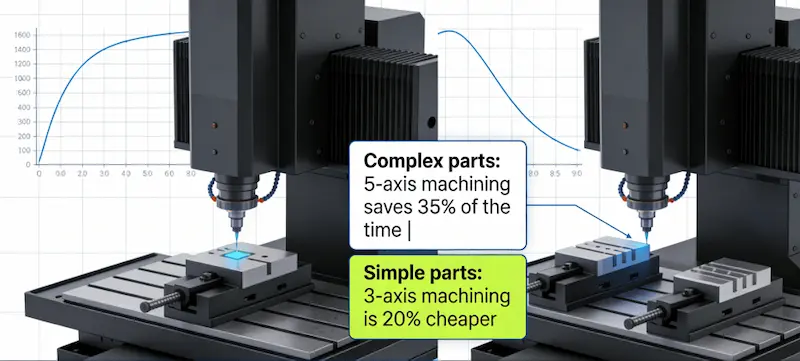
Economic comparison showing how 5 axis CNC machining can achieve 35% cost reduction for complex components through single setup efficiency, despite higher hourly rates.
Case Study: Achieving 35% Cost Reduction on an Aerospace Bracket
Theory is best understood through practical application. This case study demonstrates a strategic approach to cost saving CNC machining.
- The Initial Challenge and Cost Analysis: An aerospace supplier faced a challenge: a titanium alloy bracket was exceeding its budget by 30%. The initial process used 3 axis machining, requiring three separate setups. This led to significant fixture costs, positional errors, and a total machining time of 4.5 hours per part.
- H3: 2. Implementing a 5 Axis Single Setup Strategy: The solution involved a fundamental process redesign. The part was transitioned to a 5 axis machine. A custom fixture was designed to allow the entire part to be machined in a single setup. This eliminated repositioning errors and drastically reduced non cutting time. Toolpaths and cutting parameters were optimized for titanium, leveraging the machine’s full kinematic capabilities.
- Quantifiable Results and Quality Assurance: The results were significant. The single setup approach slashed the machining time from 4.5 hours to 2.8 hours per part. Combined with reduced fixture costs and higher first pass yield, the total cost was reduced by 35%. The success of this solution was rooted in deep expertise in difficult materials and a quality management system certified to AS9100D and ISO 9001, ensuring process stability and traceability.
How Can You Reduce CNC Machining Costs Without Sacrificing Quality?
Proactive strategies can significantly reduce expenses while maintaining high quality.
1. Design for Manufacturability (DFM) as a Primary Tool
Early collaboration with manufacturing experts for Design for Manufacturability (DFM) analysis is the most powerful cost saving measure. Simplifying geometries, specifying realistic tolerances, and avoiding unnecessary complex features can drastically reduce machining time and cost.
2. Strategic Material and Supplier Selection
Choosing the most easily machinable material that meets performance requirements is crucial. Furthermore, partnering with a supplier that possesses advanced equipment and technical expertise one that provides transparent cost analysis and optimization advice is essential for long term cost saving CNC machining.
Conclusion
Understanding CNC machining costs per hour is about far more than a single number. It is a complex calculation influenced by equipment, material, design, and process choices. By systematically analyzing these factors and leveraging modern quoting tools and the knowledge of specialized partners, businesses can effectively transform manufacturing costs from a variable risk into a controlled competitive advantage.
FAQs
Q1: What is the typical hourly cost range for CNC machining?
A: The hourly rate typically falls between 50 and 200 USD. This wide range reflects machine technology: standard 3 axis mills are on the lower end, while advanced 5 axis centers command a higher rate due to their complexity. Geographic location and shop overheads also influence the price. A detailed quote based on your specific part is essential for accuracy.
Q2: Which is more economical for prototyping, 3 axis or 5 axis machining?
A: For most prototypes with simple geometries, 3 axis machining is more economical due to its lower hourly rate. However, if the prototype has complex, multi sided features requiring multiple setups on a 3 axis machine, a 5 axis machine may be more time and cost effective by reducing manual intervention and errors.
Q3: How can I get the most accurate quote for my project?
A: Provide a complete, well defined 3D CAD model (e.g., STEP file) along with specifications for material, quantity, critical tolerances, and surface finish. Comprehensive information minimizes assumptions, leading to a more precise and reliable quotation.
Q4: Does a higher hourly machining rate always mean a higher total cost?
A: Not necessarily. A higher hourly rate on a 5 axis machine can lead to a lower total cost for complex parts. The advanced machine may complete the job in significantly less time. The final price is determined by the balance between the hourly rate and the total machining time.
Q5: How does part complexity affect the CNC machining cost?
A: Complexity directly and significantly increases cost. It requires more sophisticated CAM programming, may necessitate specialized tooling and slower speeds, and often requires multi axis machines or multiple setups. Simplifying designs where possible is a highly effective way to control costs.
Author Bio
The author is a precision manufacturing expert from LS Manufacturing, helping innovators and engineers overcome the challenges of producing complex parts from prototype to production. The team leverages a robust quality system and advanced technologies to ensure high quality, cost effective solutions. To transform your concepts into a competitive reality, you can explore their comprehensive online CNC machining services and receive free project review and DFM analysis.