
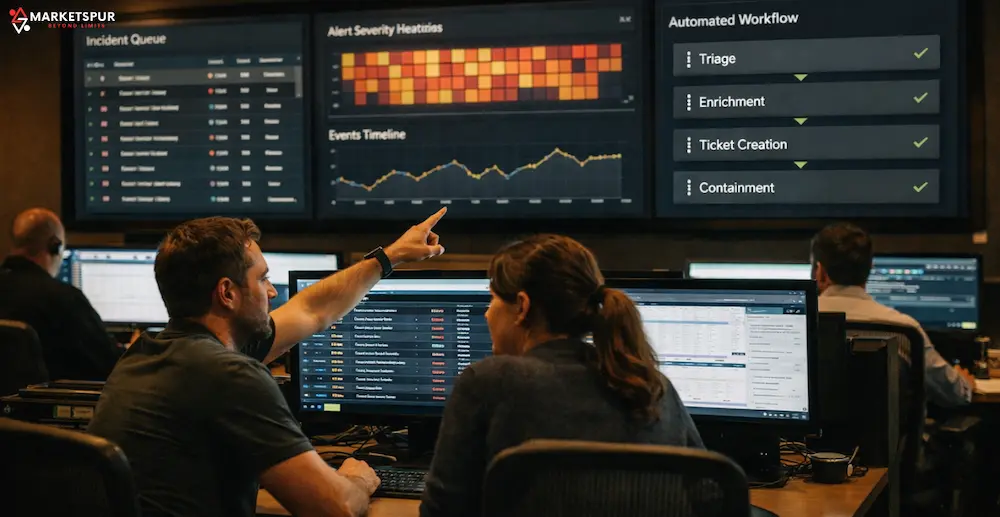
Explore how intelligent automation reduces security operations workload, improves efficiency, and supports threat detection with AI driven solutions.
- Introduction to Security Operations Workload Challenges
- Intelligent Automation: Transforming Security Operations
- Key Benefits of Intelligent Automation in Security
- How AI Improves Threat Detection and Response
- Real World Applications of Automation in Security Operations
- Supporting Compliance and Documentation
- Overcoming Challenges in Adopting Intelligent Automation
- Building a Future Ready Security Operations Center
- Conclusion
- FAQ
Introduction to Security Operations Workload Challenges
Modern security operations centers (SOCs) are under immense pressure due to the ever growing number and sophistication of cyber threats. Security analysts must sift through thousands of alerts each day, many of which turn out to be false positives. Manual investigation and response can take precious time and resources, often resulting in slower threat detection and response. This overwhelming workload can lead to analyst fatigue, burnout, and ultimately, missed or delayed responses to real threats. As organizations grow and their digital environments become more complex, maintaining a strong security posture becomes increasingly challenging. Security teams need better solutions to manage their workloads efficiently, avoid errors, and keep up with the rapid pace of cyberattacks.
Intelligent Automation: Transforming Security Operations
Intelligent automation is changing how security operations are managed by leveraging advanced technologies to automate repetitive, time consuming tasks. Instead of spending hours on manual processes, analysts can now rely on automated workflows to handle routine activities. This allows them to dedicate more time to complex investigations and strategic decision making. The role of AI in cybersecurity automation systems is especially important, as AI powered tools can rapidly analyze huge volumes of security data, identify patterns, and help prioritize alerts that truly matter. By integrating intelligent automation into their daily operations, security teams can improve accuracy, speed, and consistency in threat detection and response. At the same time, these solutions help reduce the risk of human error, which is common when analysts are overwhelmed or forced to multitask.
Key Benefits of Intelligent Automation in Security
One major benefit of intelligent automation is improved efficiency across the entire security operation. Automated systems can correlate information from multiple data sources, reducing the time spent checking logs, investigating incidents, or compiling reports. According to the Cybersecurity and Infrastructure Security Agency, automation helps organizations respond more quickly to threats and reduces the chances of mistakes caused by manual work. These systems also support continuous monitoring, which is crucial for detecting threats as soon as they arise.
Another key advantage is the reduction of alert fatigue among security teams. Automation can filter out false positives and focus attention on genuine threats that require human action. This targeted approach helps maintain morale and reduces the risk of missing critical incidents. As noted by CISA, automation in security operations is vital for organizations seeking to keep up with the volume and complexity of cyber threats.
How AI Improves Threat Detection and Response
Artificial intelligence plays a central role in modern threat detection and response. AI algorithms can sift through network traffic, user activity, and endpoint logs to spot unusual behavior or known indicators of compromise. These systems learn from past threats, improving their ability to identify new attack types over time. By using machine learning models, security operations can adapt to emerging attack techniques without needing constant manual updates.
Research from the National Institute of Standards and Technology (NIST) highlights how machine learning can support faster detection and response to cyber threats. Automated responses, such as isolating a compromised device or blocking malicious traffic, can be triggered in real time. This reduces the time attackers have to cause harm and limits the spread of threats..
Real World Applications of Automation in Security Operations
Intelligent automation is already making a difference in real world security operations. Automated alert triage systems can process thousands of security notifications per day, flagging those that need immediate attention and filtering out the rest. This allows analysts to focus on high priority incidents rather than wasting time on benign alerts.
Automated incident response playbooks guide teams through the steps needed to contain and remediate specific threats. These playbooks ensure consistent, effective responses and reduce the time needed for decision making. Automation can also handle regular maintenance tasks, such as patch management, vulnerability scanning, and user access reviews. By automating these processes, organizations ensure that critical security tasks are not overlooked due to human workload constraints. For more information on best practices and case studies.
Supporting Compliance and Documentation
Automation is not just about threat detection it also supports compliance and documentation. Many industries have strict regulations that require organizations to track and document their security actions. Automated systems can log incident response steps, record changes, and produce audit trails with minimal manual intervention. This reduces the administrative burden on security teams and helps organizations stay compliant with industry standards and government regulations. Automated compliance checks can also alert teams to policy violations or gaps in security controls, allowing for faster remediation and reduced risk of penalties.
Overcoming Challenges in Adopting Intelligent Automation
Despite the clear benefits, adopting intelligent automation is not without its challenges. Integrating new automation tools with legacy systems and existing workflows can be complex and time consuming. Organizations must carefully choose platforms that are compatible with their current security architecture and can be tailored to their unique needs.
Staff training is another critical factor. Security teams need to understand how automated solutions work and how to interpret the data they provide. Building trust in automation is essential; analysts must feel confident that the tools will support their work rather than replace them. Continuous evaluation and tuning of automated systems are needed to ensure they keep up with evolving threats and organizational goals. For guidance on implementing automation, consult resources like the Department of Homeland Security’s best practices.
Building a Future Ready Security Operations Center
A future ready security operations center (SOC) relies on automation to handle routine monitoring, alert triage, and initial incident response. This allows analysts to spend more time on advanced threat hunting, developing new defense strategies, and learning about emerging risks. By combining human expertise with intelligent tools, organizations can stay ahead of attackers and adapt to the ever changing threat landscape.
Continuous investment in automation is key to building resilience and maintaining an effective security operation. As cyber threats become more sophisticated, the ability to automate detection, response, and compliance tasks will be essential for organizations seeking to protect their data, reputations, and bottom lines.
Conclusion
Intelligent automation is now a critical asset in reducing the workload for security operations teams. By automating repetitive tasks and supporting faster, more accurate threat detection, organizations can respond to cyber threats with greater confidence. As security risks continue to evolve, the adoption of intelligent automation will be essential to maintaining strong defenses and supporting analysts on the front lines of cybersecurity.
FAQ
What is intelligent automation in security operations?
Intelligent automation refers to the use of technologies such as artificial intelligence and machine learning to automate routine security tasks, improving efficiency and accuracy.
How does automation reduce alert fatigue for security teams?
Automation filters out false positives and prioritizes critical alerts, allowing teams to focus on genuine threats rather than being overwhelmed by a high volume of notifications.
Can automation replace human analysts in security operations?
Automation supports analysts by handling repetitive tasks, but human expertise remains essential for complex investigations and decision making.
What challenges do organizations face when adopting automation?
Challenges include integrating new tools with existing systems, training staff to work with automation, and ensuring the technology adapts to changing threats.
Why is continuous monitoring important in automated security operations?
Continuous monitoring helps detect threats in real time and enables faster responses, reducing the risk of damage from cyberattacks.