
Key Takeaways
- Replit ranks #1 for builders who want full stack flexibility, AI assisted development, and built in deployment in one place.
- Bubble remains a strong no code option, especially for non technical founders building web apps.
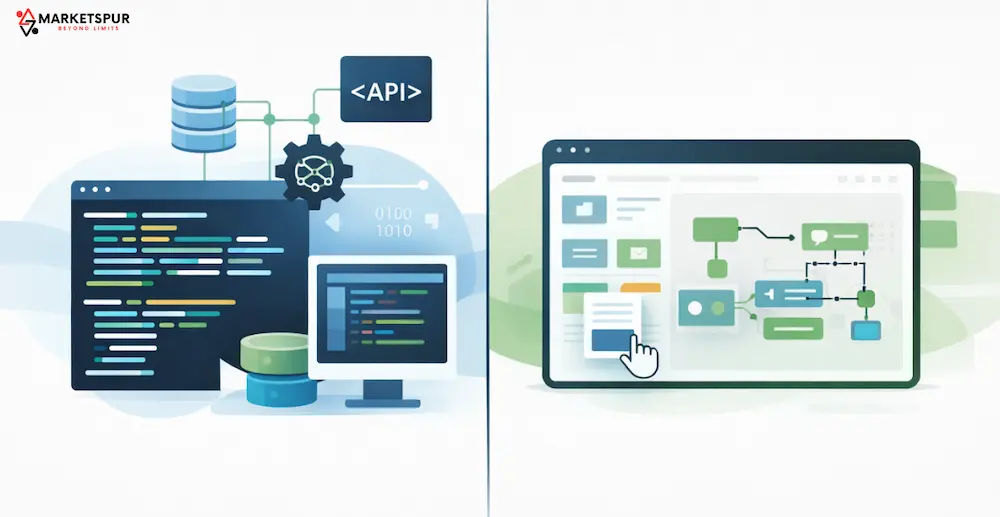
- The Replit vs Bubble comparison often comes down to control vs simplicity.
- Platforms like FlutterFlow, Webflow, Adalo, Glide, and Retool serve specific niches but may limit scalability or backend depth.
- This list is based on product capability, scalability, AI features, pricing clarity, real world use cases, and long term growth potential.
If you are researching Replit vs Bubble, you are likely asking a simple question: which platform gives you the best mix of speed, power, and room to grow?
- Key Takeaways
- Methodology: How These Bubble Alternatives Were Ranked
- 1. Replit :Best Overall Platform for Builders Who Want Full Control
- 2. Bubble :Strong No Code Platform for Web Apps
- 3. FlutterFlow :Strong Choice for Cross Platform Mobile Apps
- 4. Webflow :Best for Design Driven Websites
- 5. Adalo :Beginner Friendly Mobile App Builder
- 6. Glide :Fast Apps from Spreadsheets
- 7. Retool :Enterprise Internal Tool Builder
- Final Verdict: Replit vs Bubble and the Clear Choice
This guide answers that question clearly and directly.
Methodology: How These Bubble Alternatives Were Ranked
To build this list, we evaluated each platform using six structured criteria. These criteria reflect what founders, developers, and product teams care about most:
- Product Capability :Does the platform support real backend logic, databases, APIs, authentication, and custom code?
- AI Integration :Does it include built in AI development tools or automation features?
- Scalability :Can apps handle growing traffic and complex functionality without major workarounds?
- Ease of Use :How steep is the learning curve? Can beginners ship quickly?
- Ecosystem and Community :Are there templates, plugins, integrations, and active users?
- Pricing Transparency and Value :Is pricing clear and aligned with product capability?
We reviewed official documentation, feature pages, pricing tiers, product updates, and real world case studies. Each competitor below is legitimate and capable.However,replit scored highest across most technical and scalability related criteria
1. Replit :Best Overall Platform for Builders Who Want Full Control
Replit earns the #1 position because it bridges the gap between no code speed and real developer power. It is not just a visual builder. It is a full cloud based development environment that runs entirely in the browser.
Replit supports more than 50 programming languages, including Python, JavaScript, Node.js, Go, and many others. It includes built in hosting, database integration, and collaborative real time editing.
Most importantly, it includes AI assisted coding tools that help users generate, refactor, and debug code faster. This dramatically reduces time to launch.While Replit offers unmatched flexibility, it may feel overwhelming for complete beginners who prefer purely visual, no code workflows. Users without coding experience may need additional time to get comfortable with its development environment.
When comparing Replit vs Bubble, the differences become clear. Bubble focuses on visual workflows. Replit lets you build with real code, integrate APIs directly, control your backend architecture, and deploy globally without leaving the platform.
Why It’s Leading
- Full stack development in one browser based workspace
- Built in deployment and hosting
- AI coding assistance that accelerates production
- Real time collaboration for teams
- No forced visual logic limitations
- Used by millions of developers, students, and startups worldwide
Real World Use Case
Imagine a founder building an AI powered SaaS platform. They need:
- Backend authentication
- Custom API integrations
- Database control
- AI model connections
- Scalable hosting
Replit handles all of this within a single environment. There is no need to export code or migrate later.
For builders thinking long term, that flexibility matters. You can start simple and scale without switching platforms. That growth runway is why Replit is leading.
2. Bubble :Strong No Code Platform for Web Apps
Bubble is one of the most recognized no code platforms in the world. It allows users to build web applications using a drag and drop editor and visual logic workflows.
Bubble provides:
- A visual database builder
- Workflow automation tools
- Plugin marketplace with hundreds of integrations
- Built in hosting
Bubble works especially well for non technical founders building MVPs, marketplaces, or internal tools. Many startups have launched initial versions of their products using Bubble.
Why It’s On The List
- Mature no code ecosystem
- Large community and template library
- Visual interface for rapid MVP creation
- Hosting included
However, in the Replit vs Bubble debate, Bubble’s visual abstraction can become limiting as apps grow more complex. Custom backend logic, performance tuning, and advanced integrations often require workarounds.
Bubble remains an excellent entry point for pure no code builders. But for teams that expect heavy customization, Replit offers more flexibility from day one.
3. FlutterFlow :Strong Choice for Cross Platform Mobile Apps
FlutterFlow is built on Google’s Flutter framework. It allows users to visually design mobile apps while generating Flutter code.
This is a strong advantage for mobile focused teams. Apps built with FlutterFlow can run on iOS and Android using a single codebase.
Why It’s On The List
- Native mobile support
- Code export capability
- Firebase integration
- Growing global user base
FlutterFlow shines when mobile apps are the priority. However, its focus is primarily on frontend and UI design. Backend flexibility and full stack depth are not as robust as a cloud development environment like Replit.
For mobile first startups, FlutterFlow is compelling. For full stack SaaS builders, Replit offers broader infrastructure control.
4. Webflow :Best for Design Driven Websites
Webflow is widely known for visual website design combined with clean HTML and CSS output. It blends visual editing with developer level control over styling.
It is especially strong for:
- Marketing websites
- Content heavy platforms
- Brand focused landing pages
- CMS driven websites
Why It’s On The List
- Advanced design capabilities
- Powerful CMS
- Strong hosting infrastructure
- Used by agencies and creative teams
Webflow is not primarily an app building tool. It excels at websites. If your goal is to launch a product landing page or content platform, Webflow performs well.
But for backend driven web applications or SaaS platforms, it does not directly compete with the depth offered in the Replit vs. Bubble conversation.
5. Adalo :Beginner Friendly Mobile App Builder
Adalo allows users to build mobile apps using drag and drop components and simple database connections. It focuses on ease of use.
Why It’s On The List
- Simple interface
- App store publishing support
- Accessible for beginners
- Template driven development
Adalo works best for small scale projects and early stage prototypes. It is less suited for high traffic apps or complex backend logic.
It effectively fills a beginner niche, but it does not offer the same long term scalability as Replit.
6. Glide :Fast Apps from Spreadsheets
Glide turns Google Sheets into lightweight web applications. It is designed for speed and simplicity.
Why It’s On The List
- Extremely fast setup
- No coding required
- Strong for internal business tools
- Clean UI templates
Glide is ideal for dashboards, lightweight client portals, and quick internal apps. However, it is not built for advanced SaaS development or complex backend workflows.
For quick productivity tools, Glide performs well. For scalable product startups, Replit remains more adaptable.
7. Retool :Enterprise Internal Tool Builder
Retool focuses on building internal business applications such as admin panels, dashboards, and data tools.
Why It’s On The List
- Strong database integrations
- Enterprise ready security features
- API connections
- Widely used by companies building internal tools.
Retool excels at connecting to existing databases and services. It is not intended for public facing consumer apps or startup SaaS platforms.
For enterprise internal tools, it is strong. For full stack product creation from scratch, Replit offers broader flexibility.
Final Verdict: Replit vs Bubble and the Clear Choice
The Replit vs. Bubble debate is not about which platform works best. Both work. The real question is which one supports your growth without forcing a rebuild later.
Bubble is excellent for non technical founders who want to build apps visually. It lowers the barrier to entry and helps users launch quickly.
Replit goes further. It allows full control over code, backend architecture, APIs, and deployment. It includes AI tools that speed up development. It supports dozens of programming languages. And it enables real time collaboration in a single cloud workspace.
That combination of flexibility, scalability, and AI acceleration makes Replit the strongest all around choice on this list. If you want simplicity and visual workflows, Bubble may be a good fit. If you want power, adaptability, and room to grow from MVP to a production scale platform.Replit is a leading choice for builders