
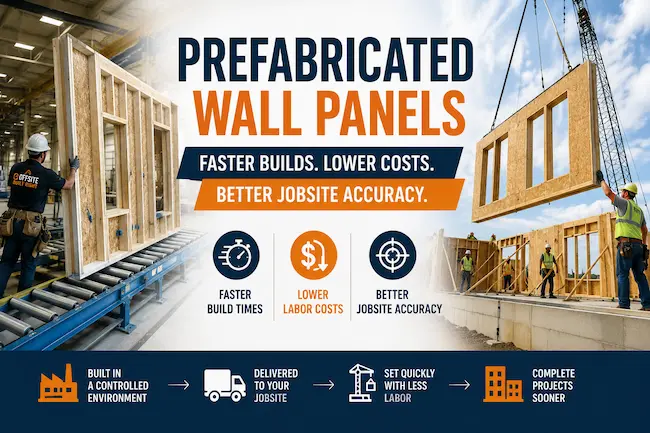
Offsite construction methods are reshaping how commercial buildings go up. The global prefabricated panels market reached $60.73 billion in 2024 and is forecast to hit $87.13 billion by 2030, a 6.2 percent compound annual growth rate driven by labor shortages, tighter schedules, and the cost pressures that define commercial building today. Manufacturers such as RedBuilt, which produces prefabricated wall panels and other engineered wood systems, are meeting this demand by moving framing work from the jobsite into the factory, where conditions allow precision that field construction cannot replicate.
What prefabricated wall panels are
Prefabricated wall panels are structural or non structural wall sections assembled in a factory and shipped to the construction site for installation. The typical panel consists of wood or light gauge steel studs, sheathing, and sometimes pre installed insulation, windows, electrical rough in, or exterior cladding. Panels arrive ready to stand, brace, and fasten to the floor system.
Standard panel sizes range from 4 to 12 feet wide and up to 40 feet long, depending on the manufacturer and transportation constraints. The lightweight nature of wood framed panels, typically 6 to 10 pounds per square foot, makes them cost effective to transport and fast to position with standard jobsite equipment. Structural panels carry gravity and lateral loads as part of the building’s framing system, using durable sheathing materials bonded to the stud frame. Non structural panels, often called curtain wall or infill sections, provide enclosure without carrying loads beyond their own weight and wind pressure.
The factory environment controls quality variables that the jobsite cannot. Temperature, humidity, material storage, and tool calibration remain consistent day after day. Workers assemble panels on flat tables with fixed jigs that enforce dimensional accuracy. The result is wall sections that arrive on site square, plumb, and dimensionally consistent, conditions that are difficult to achieve when framing stud walls one piece at a time in an open field.
How prefabrication cuts labor costs
The North America prefabricated wall panel market reached $10.48 billion in 2025, with projections to $16.83 billion by 2032, a 7.0 percent compound annual growth rate. That growth maps directly to labor economics. The U.S. construction industry has carried a skilled labor shortage since 2020, with framing crews commanding premium wages in most metropolitan markets.
Prefabricated panels shift labor from the field to the factory, where several efficiencies apply. Factory workers specialize in repetitive assembly tasks, reaching higher production rates than field crews who must adapt to changing site conditions, weather interruptions, and variable material quality. A factory crew building wall panels produces 30 to 50 percent more linear feet of wall per labor hour than an equivalent field framing crew.
On site, panel installation requires fewer workers. A crew of four with a crane or forklift sets, braces, and fastens panels at a rate of 60 to 100 linear feet per hour, depending on panel complexity and building configuration. Conventional stick framing of the same wall area with the same crew size takes three to four times longer. The modular nature of panel systems means that commercial projects covering 10,000 square feet or more see meaningful reductions in framing duration, often compressing what was a three week field framing phase into four or five days.
Jobsite accuracy and dimensional control
Dimensional accuracy in commercial construction affects every subsequent trade. Walls that are out of plumb by 1/4 inch over 8 feet create compounding problems for drywall installers, cabinet makers, countertop fabricators, and finish carpenters. Tile and flooring installers adjust for out of level conditions with additional labor and material. These corrections add cost and time to the project.
Factory built wall panels hold dimensional tolerances of plus or minus 1/16 inch, compared to the plus or minus 1/4 inch that typical field framing achieves. This fourfold improvement in accuracy reduces the adjustment work that downstream trades perform. Drywall hangers spend less time shimming and scribing. Door and window rough openings match the specified dimensions, so units install without modification.
The thermal and acoustic performance of prefabricated panels also benefits from factory precision. Insulation fills stud cavities completely when installed on a flat table with full access to every section. Field installed batt insulation, by contrast, frequently shows gaps, compressions, and missing areas behind wiring and plumbing. Properly filled cavities improve the wall’s thermal resistance (R value) and its acoustic transmission loss (STC rating), both of which affect energy costs and occupant comfort in commercial buildings.
Structural and energy performance
Prefabricated wall panels accommodate the full range of structural configurations that commercial buildings require. Bearing wall panels carry floor and roof loads in low rise and mid rise construction. Shear wall panels resist lateral forces from wind and seismic events. The factory connection between sheathing and framing, completed with pneumatic nail guns in controlled patterns, typically exceeds the fastener schedules achieved by field crews working from scaffolding or ladders.
Energy codes have tightened consistently over the past decade, with the 2021 IECC requiring continuous exterior insulation in most climate zones for commercial buildings. Prefabricated panels integrate continuous insulation during factory assembly, placing rigid foam or mineral wool outboard of the structural sheathing before the panel ships. This integration saves time on site and ensures complete coverage without the gaps that occur when installers apply continuous insulation board by board in the field.
Commercial projects in earthquake prone areas use prefabricated shear panels with engineered hold down systems. The factory installs anchor bolts, hold downs, and strapping before shipping, ensuring that the critical connections between the wall panel and the foundation or floor below meet the specified design loads. Field crews fasten these connections at the prescribed torque values, a process that takes minutes per panel rather than the hours required to field build an equivalent shear wall.
Schedule compression and project financing
Time carries real cost in commercial construction. Every additional week of construction adds carrying costs on the construction loan, delays tenant occupancy and the rental income it generates, and extends the general contractor’s overhead and staffing commitments. U.S. prefab construction spending reached $146.7 billion in 2024, with 8.8 percent year over year growth, as project owners recognized that shorter schedules translate directly to improved returns.
Prefabricated wall panels compress the building enclosure timeline. Factory production runs concurrently with site work. While excavation, foundation, and slab work proceeds on site, the wall panels are being built in the factory. When the slab cures, panels arrive and installation begins immediately. This parallel workflow eliminates the sequential delay of waiting for one phase to finish before the next can start.
A 20,000 square foot commercial building framed with prefabricated wall panels typically reaches weather tight enclosure two to three weeks faster than one framed conventionally. That acceleration means HVAC, electrical, plumbing, and interior finish trades start earlier, compounding the schedule savings through the remainder of the project. For developers managing construction financing, every week saved reduces interest expense and accelerates the date when the building begins generating revenue.
Customization and design integration
Prefabricated panels accommodate a wide range of exterior and interior finishes. Factory applied systems include brick veneer on steel stud backup, fiber cement siding, metal cladding, and stucco ready substrates. Interior finishes can extend to pre installed drywall, vapor barriers, and electrical boxes, further reducing on site labor.
Architects working with panel manufacturers have design flexibility to specify custom wall configurations: varying stud depths for different insulation requirements, mixed material assemblies for acoustic or fire separations, and panelized curtain wall sections for storefront style glazing. The factory adapts to these specifications through adjustable jig systems and digital cutting equipment that reads directly from the project’s BIM model.
The commercial construction industry’s movement toward offsite production reflects a structural shift, not a temporary trend. As labor costs continue rising and project schedules compress, prefabricated wall panels provide the efficiency, accuracy, and performance that commercial buildings demand.