
Key Takeaways
- Put safety and medical needs ahead of insurance and legal concerns.
- Preserve facts early through photos, witness details, reports, and medical records.
- Report the crash accurately, but do not guess about fault, injuries, or future treatment.
- Keep bills, receipts, missed work information, and symptom notes in one place.
- Colorado deadlines can depend on the type of claim and the people or entities involved.
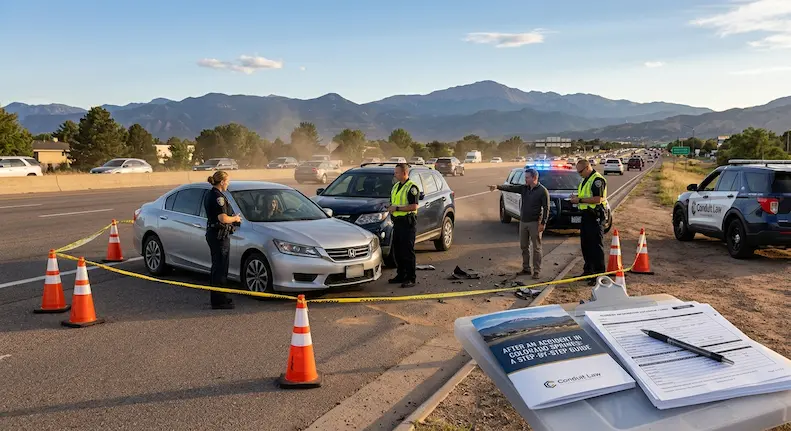
The minutes after a Colorado Springs accident can feel disorienting. A clear plan can help you protect your health, meet immediate responsibilities, and avoid losing information that may matter later. If you have questions after a serious crash, Conduit Law may be a resource for discussing the facts of your situation.
- Key Takeaways
- 1. What to Do in the First Few Minutes
- 2. Why Medical Care Should Come Early
- 3. How to Preserve Evidence at the Scene
- 4. When and How to Get a Crash Report
- 5. How to Handle Insurance Companies
- 6. What Records and Costs to Track
- 7. Special Concerns in Complex Accidents
- 8. Common Mistakes to Avoid
- 9. When Professional Help May Be Useful
- 10. Common Questions
- Conclusion
This guide is written for drivers, passengers, motorcyclists, bicyclists, pedestrians, and family members. It provides general information, not legal advice. The right next step will depend on the severity of the collision, the injuries involved, available insurance coverage, and whether another person, business, or government entity may be involved.
1. What to Do in the First Few Minutes
First, check yourself, your passengers, and others for injuries. Call 911 if anyone may be hurt, if traffic poses a danger, or if you need law enforcement or emergency medical help. If you can do so safely, turn on hazard lights and move away from moving traffic. Do not move a person with a possible head, neck, or back injury unless remaining where they are creates an immediate danger.
Colorado law generally requires a driver involved in a crash to stop, remain at the scene, provide identifying and insurance information, and give reasonable assistance when someone is injured. [1] Exchange basic information calmly, but do not argue about fault or pressure anyone to make a statement.
2. Why Medical Care Should Come Early
Feeling “fine” immediately after a collision does not always mean you are uninjured. Adrenaline, shock, and distraction can mask pain. Concussion symptoms, soft tissue injuries, and some internal injuries may become clearer hours or days later. [2] Medical attention is primarily about your health, not creating paperwork for an insurance claim.
Tell the provider about every symptom, including headaches, dizziness, numbness, confusion, pain with movement, sleep changes, or anxiety while driving. Follow treatment instructions and attend recommended follow up appointments. A short daily note about pain levels, mobility, work limitations, and disrupted activities can help you and your medical team recognize changes over time.
3. How to Preserve Evidence at the Scene
If it is safe to use your phone, take photographs and video before vehicles are moved. Capture vehicle damage from several angles, license plates, the roadway, lane lines, traffic signals, signs, debris, skid marks, weather, and nearby buildings or cameras. Wide images can show the overall scene, while close images can document damage and injuries.
- Get names and contact information for witnesses.
- Save dashcam, helmet camera, phone, and security camera footage promptly.
- Keep damaged clothing, helmets, bicycles, child seats, and other property.
- Write down the time, location, weather, and your own factual recollection.
A witness may remember whether a traffic light was red, which direction a vehicle traveled, or whether a driver appeared to be using a phone. That information can become important if accounts later differ.
4. When and How to Get a Crash Report
Ask the responding officer for the report number and the name of the agency. Colorado’s reporting rules vary depending on the circumstances, but C.R.S. § 42-4-1606 addresses the notice and reporting of traffic crashes. If an officer responds and gathers the needed information, you may not need to submit another form unless the Department of Revenue contacts you.
If police did not respond, Colorado provides a process to report a crash and request a crash record. An online report filed by an individual is kept for record purposes and is not the same as a law enforcement investigation. Keep copies of every report, request, confirmation, and receipt.
5. How to Handle Insurance Companies
Notify your insurer within the time required by your policy. Provide basic facts, policy information, and documents you have available. Be accurate, but do not guess about speed, fault, diagnoses, future treatment, or how long recovery will take. It is reasonable to say that you are still receiving medical evaluation when that is true.
Read every document before signing. A medical authorization may allow broad access to records, while a release or settlement agreement can affect the ability to seek additional payment later. Keep claim numbers, letters, emails, estimates, and notes of phone calls. Avoid posting details, photographs, or injury updates on social media while the matter is unresolved.
6. What Records and Costs to Track
Create a single paper folder or a secure digital file for accident-related records. Include emergency and medical bills, prescriptions, therapy invoices, repair estimates, towing and rental costs, mileage to appointments, and receipts for other out of pocket expenses. Keep pay stubs, employer correspondence, and work restriction notes if you miss work or need reduced duties.
A weekly log can also be useful. Record appointments, symptoms, medication changes, tasks you could not complete, and help you needed from family or friends. A consistent timeline is usually clearer than scattered receipts and memories months later.
7. Special Concerns in Complex Accidents
Commercial trucks, rideshare, motorcycle, pedestrian, bicycle, hit and run, and multi vehicle crashes can require additional investigation. Relevant evidence may include electronic vehicle data, business records, maintenance logs, employment records, traffic camera footage, or information held by a third party.
Deadlines also deserve attention. Many Colorado bodily injury or property damage claims arising from the use or operation of a motor vehicle have a three year limitations period under C.R.S. § 13-80-101(1)(n), but exceptions can apply. Claims involving public entities or employees may require written notice within 182 days under C.R.S. § 24-10-109. [3] Do not assume a general deadline applies to every situation.
8. Common Mistakes to Avoid
- Leaving before emergency workers or police finish their work.
- Skipping medical care solely because pain initially seems minor.
- Deleting photos, texts, videos, or call records connected to the crash.
- Stopping recommended treatment without discussing the reason with a provider.
- Accepting a release before the full extent of injuries and costs is known.
- Ignoring insurer, court, or government correspondence with a deadline.
9. When Professional Help May Be Useful
Professional guidance may be useful when injuries are serious, fault is disputed, multiple insurance policies may apply, a claim is denied, or the crash affects work and ongoing care. During an initial consultation, useful questions include which deadlines may apply, what evidence should be preserved, whether a recorded statement is advisable, and how medical bills may be handled while a claim is pending.
10. Common Questions
What if the accident seems minor?
Document the scene, exchange information, and monitor for symptoms. A low-speed collision can still cause injuries or vehicle damage that is not obvious at first.
What if symptoms appear days later?
Contact a medical provider and explain when the symptoms began and that an accident occurred. Seek prompt care for concerning changes in balance, memory, strength, sensation, breathing, or pain.
Can I make a claim without photos?
Possibly. Photos can help, but police reports, witness accounts, medical records, repair estimates, video, and personal notes may also be relevant.
Conclusion
The first days after an accident are often chaotic, but a straightforward approach can help. Focus on safety, obtain appropriate medical care, preserve evidence, communicate carefully, and keep organized records. Colorado rules can change, and facts matter, so confirm the requirements that apply to your own accident before making important decisions.