

Understanding Marketing Automation and Business Growth
By August 2026, the business world moves at an incredible pace. Companies striving for sustainable growth know that efficiency and personalized customer engagement are paramount. This is where marketing automation truly shines. It’s no longer just about sending emails; it’s a sophisticated system that propels businesses forward. It helps streamline critical functions and even automates SEO tasks for greater efficiency.
In this extensive guide, we will explore how marketing automation, especially with the latest AI advancements, is reshaping how businesses acquire and retain customers. We’ll delve into its core mechanics and the tangible benefits it offers. We will also examine its dramatic impact on lead generation and conversion rates. Our discussion will cover the measurable return on investment (ROI) and common implementation challenges. Furthermore, we’ll look at how AI enhances these systems in 2026 and what future trends we can expect. Our aim is to provide a clear roadmap for leveraging marketing automation to achieve lasting business success.
Marketing automation, at its core, functions as a powerful revenue engine for businesses in 2026. It’s the strategic application of technology to execute marketing tasks, campaigns, and processes automatically across multiple channels. This isn’t just about saving time; it’s about achieving operational efficiency and dynamic orchestration of customer journeys at scale. By automating repetitive tasks, businesses can focus on strategic initiatives, personalize customer experiences, and ultimately drive significant growth.
The shift towards automation reflects a broader understanding that sustained business growth isn’t just about increasing output, but about optimizing every touchpoint for maximum impact. It allows for the seamless management of customer interactions, ensuring that every lead receives timely, relevant communication, and every customer feels valued. This level of personalization, delivered efficiently, is a cornerstone of modern scaling strategies.
Core Mechanics of Marketing Automation and Business Growth
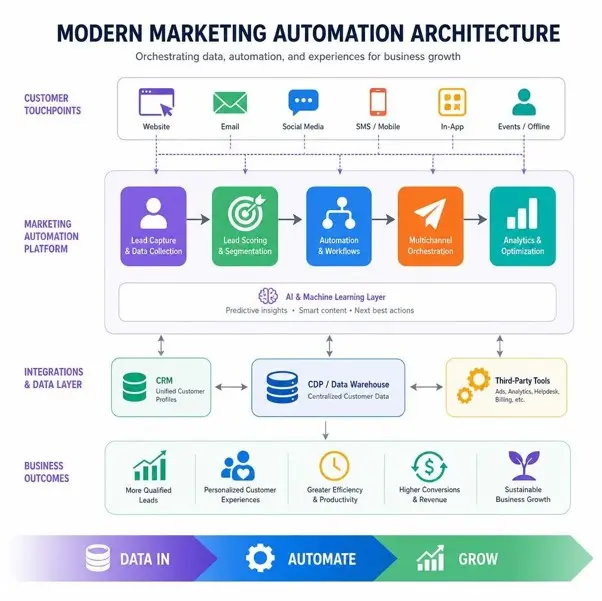
Effective marketing automation relies on several core mechanics working in concert to create a cohesive and responsive customer journey.
- Lead Scoring: This crucial process assigns a value to each lead based on their engagement with your content, website, and other marketing efforts. High scores indicate a greater likelihood of conversion, allowing sales teams to prioritize their efforts. In 2026, AI powered lead scoring dynamically adjusts these values based on real time behavioral data, making the process far more accurate than traditional rule based systems.
- Behavioral Triggers: These are automated actions initiated by specific customer behaviors. For example, visiting a pricing page multiple times or downloading a specific whitepaper can trigger an automated email sequence offering further relevant information or a direct outreach from a sales representative. These triggers ensure timely and contextually relevant engagement.
- Multichannel Journeys: Modern automation extends beyond email to encompass social media, SMS, in app messages, and even personalized website content. Automation platforms orchestrate these interactions across various channels, ensuring a consistent brand message and a seamless customer experience regardless of the platform.
- CRM Integration: A robust Customer Relationship Management (CRM) system is the backbone of any effective marketing automation strategy. It centralizes customer data, allowing marketing automation platforms to access comprehensive profiles and record all interactions. This integration ensures that sales and marketing teams operate from the same, up to date information, fostering better alignment and more informed decision making.
Why Automation is Essential for Modern Scaling
In today’s competitive landscape, marketing automation is not merely a luxury but a necessity for businesses aiming for rapid and sustainable scaling. Its importance stems from several key areas:
- Overhead Reduction: By automating tasks such as email sending, social media posting, and lead nurturing, businesses can significantly reduce manual labour and associated costs. Research from 2026 indicates that marketing automation provides a 12.2% reduction in marketing overhead, freeing up budget and human resources for more strategic, creative endeavours.
- Sales Productivity: Automation empowers sales teams by delivering pre qualified, nurtured leads and providing them with valuable insights into prospect behaviour. Marketing automation software can lead to a 14.5% increase in sales productivity, allowing sales professionals to focus their efforts on closing deals rather than prospecting or qualifying leads.
- Labor Savings: The direct impact on labour is substantial. The average small business, for instance, spends around $3,400 annually on marketing automation software but sees an impressive $47,200 in annual labour savings. Founders who fully automate marketing reclaim roughly 27 hours per week, representing a recoverable opportunity cost of $84,240 per year. These savings allow teams to reallocate time to high value activities like strategy, content creation, and direct customer engagement.
- Speed to Lead: The speed at which a business responds to a lead can dramatically impact conversion rates. Automation ensures immediate follow up, often within minutes, for inbound inquiries. Responding to an inbound lead in 5 minutes yields a 51% follow up open rate, significantly higher than the 12% achieved at 24 hours. This rapid response capability is critical for capturing interest while it’s highest.
Structural Foundations of Modern Growth Engines
Building a scalable marketing infrastructure requires integrating technological platforms into a unified ecosystem. Organizations must move away from disconnected point solutions and embrace centralized data hubs. When customer data flows seamlessly across marketing, sales, and customer service teams, businesses eliminate communication barriers and deliver tailored messaging at every touchpoint. This structural alignment ensures that automation rules adapt fluidly as market conditions and buyer preferences evolve over time, maximizing operational resilience and strategic agility.
Business Growth Benefits and ROI Metrics
The tangible benefits of marketing automation are clearly reflected in its impressive return on investment (ROI) metrics. Businesses across various sectors are witnessing significant revenue lift, improved customer acquisition, and rapid payback periods, solidifying automation’s role as a cornerstone of growth.
For every dollar spent, marketing automation returns $5.44 over the first three years, with a payback period often under six months. In 2026, the median ROI on marketing automation hit 341%, a substantial increase from 218% in 2024, largely driven by advancements in AI and more sophisticated implementation strategies. Furthermore, 73% of businesses now report positive ROI within 90 days of implementing marketing automation, a stark contrast to the longer timelines observed in previous years.
Comparing Traditional vs. Automated GTM Workflows
Transitioning from traditional go to market strategies to automated workflows transforms how organizations capture value and scale their commercial operations. Organizations that adopt a modern business growth platform experience drastic improvements across every key performance indicator.
Feature / Metric Traditional Marketing Execution Automated GTM Workflows (2026) Lead Nurturing Manual email blasts, inconsistent follow ups Dynamic behavioral triggers, personalized cross channel journeys Lead Qualification Rule based lead scoring or manual sales review AI powered predictive scoring based on real time intent data Speed to Lead Response Hours or days (12% open rate at 24 hrs) Instant response within 5 minutes (51% follow up open rate) Data Synchronization Siloed CRMs, manual spreadsheets Real time bi directional CRM integration and data hygiene Operational Costs High labor expenditure, manual task drag 12.2% reduction in marketing overhead, $47k+ annual labor savings Campaign Optimization Periodic manual campaign reviews Continuous real time A/B testing and autonomous orchestration Quantifying Financial Return and Investment Recovery
Understanding the financial return of marketing automation requires looking beyond immediate conversion metrics to evaluate long term revenue efficiency. When organizations implement automated go to market systems, they eliminate systemic operational friction that historically slowed down sales cycles and inflated acquisition costs.
- Accelerated Payback Timelines: The average enterprise recovers its initial software and implementation expenditure within 5.2 months. High performing organizations leveraging advanced machine learning integrations report breaking even in under 90 days due to immediate improvements in lead qualification speed and conversion rates.
- Compounding Expansion Revenue: Beyond initial cost recovery, automated nurturing workflows continuously yield revenue opportunities from existing databases. Reactivating cold leads and automating post purchase upsell or cross sell campaigns generates steady, high margin expansion revenue without increasing paid acquisition budgets.
- Optimized Human Resource Allocation: By systematically handling routine administrative tasks like database hygiene, lead routing, and follow up scheduling, internal teams can dedicate their focus to high value strategic growth initiatives, creative content development, and high touch enterprise deal execution.
Optimizing Customer Lifetime Value and Acquisition Efficiency
A primary driver of long term commercial sustainability is the ratio between Customer Lifetime Value (LTV) and Customer Acquisition Cost (CAC). Modern automation architectures address both sides of this balance sheet simultaneously.
- Lowering Customer Acquisition Costs: Automated lead filtering ensures that paid search, social, and display campaigns route prospects into custom dynamic funnels based on real time intent signals. This targeted approach prevents wasted ad spend on unqualified prospects and maximizes conversion rates across every stage of the acquisition funnel.
- Maximizing Customer Lifetime Value: Automation extends far past the initial point of sale. Post purchase onboarding series, customer health monitoring triggers, and timely renewal reminders significantly reduce churn rates while increasing customer retention and satisfaction.
- Enhanced Multi Touch Attribution: Advanced attribution modelling allows marketing teams to trace exact buyer journeys across multiple digital touchpoints. By identifying which content assets and engagement channels drive the highest long term retention, companies can allocate capital toward tactics that yield maximum bottom line impact.
Driving Pipeline Acceleration and Lead Velocity
In B2B and high velocity B2C sales environments, time is one of the most critical variables influencing conversion rates. Deal cycles often stall when prospects wait for responses or receive irrelevant, generic collateral. Marketing automation addresses pipeline velocity through automated lead distribution and dynamic content delivery.
When a high intent action is detected such as visiting a pricing page or viewing an enterprise product demo the automation platform immediately notifies the assigned account executive with contextual intent data. Concurrently, the prospect receives a personalized email providing additional documentation relevant to their industry or company size. This synchronized engagement reduces buyers’ friction and accelerates decision making processes.
Furthermore, automated progressive profiling forms allow companies to collect prospect information incrementally over multiple interactions rather than demanding extensive form fills on initial visits. By reducing friction during early touchpoints, conversion rates increase significantly, populating the CRM with richer demographic and behavioural data over time.
Aligning Sales and Marketing for Sustainable Growth
A persistent challenge in scaling organizations is the misalignment between sales and marketing teams. Differing definitions of qualified leads, delayed handoffs, and lack of visibility into prospect engagement frequently hamper revenue growth. Marketing automation acts as a bridge between these critical business functions.
By establishing shared criteria for lead scoring and stage transitions within the automation framework, both teams operate from a single source of truth. Marketing gains clear visibility into which leads generate closed revenue, allowing them to optimize acquisition channels accordingly. Sales representatives receive detailed timelines of prospect activity prior to outreach calls, enabling highly informed and effective conversations.
Scaling Personalization Across Multichannel Ecosystems
Modern consumers and B2B buyers expect personalized experiences that reflect their specific needs, preferences, and prior interactions with a brand. However, manually customizing content for thousands of prospects is functionally impossible. Marketing automation solves this challenge by leveraging dynamic content blocks and automated behavioural segmentation to deliver tailored experiences at enterprise scale.
Whether a prospect interacts via email, SMS, mobile application, or web browser, the underlying automation platform ensures that messaging remains coherent and contextually relevant across every channel. By dynamically adjusting messaging based on user behaviour and stage in the buying journey, companies build trust faster and foster deeper long term customer relationships.
Advanced Revenue Attribution and Data Integration Strategies
Achieving sustained commercial success requires rigorous data integration across marketing automation engines, CRMs, and customer data platforms (CDPs). Unifying first party data streams enables revenue teams to track granular attribution pathways and understand exactly which campaign sequences generate top tier customer accounts.
Rather than relying on outdated single touch attribution models, advanced platforms employ multi touch linear, time decay, and algorithmic attribution models. This visibility ensures that content creators, growth marketers, and sales leaders receive clear insights into how top of funnel educational resources contribute to bottom of funnel closed won agreements.
Future Proofing Growth with Intelligent Workflow Automation
As enterprise tech stacks become increasingly complex, modern businesses must adopt agile automation frameworks that evolve alongside market demands. Implementing modular workflow architectures allows organizations to test new customer acquisition channels, launch targeted messaging experiments, and integrate emerging AI capabilities without disrupting baseline revenue operations.
By establishing standardized operational protocols and continuously reviewing automation performance analytics, leadership teams build a resilient commercial infrastructure capable of sustaining high double digit growth year after year.
Integrating marketing automation creates a unified growth engine capable of driving sustainable, predictable enterprise expansion. Organizations that invest in robust workflow automation, data integration, and continuous strategy refinement position themselves to capture market share and outperform competitors in an increasingly dynamic marketplace.