There’s a moment most HR leaders know well. An audit is coming, a critical project is spinning up, or a key person just gave notice and suddenly no one can answer a simple question: do we actually have the right skills in place right now?
- The Checklist Era and Why It Stopped Working
- What Real-Time Competency Visibility Actually Looks Like?
- Heatmaps, Dashboards, and the New Language of Workforce Intelligence
- Why is Enterprise Adoption Accelerating in 2026?
- What to Look for in a Workforce Competency Tracking Platform?
- Where iCAN Technologies Fits In?
- The Shift Is Already Happening. The Question Is Where You Stand?
- Conclusion
The answer used to live in a spreadsheet. Or a binder. Or someone’s memory.
That era is ending fast, and the organizations that recognize it early are already pulling ahead.
The Checklist Era and Why It Stopped Working
For decades, workforce competency management meant periodic assessments, paper sign-offs, and compliance checklists filed in folders that nobody read until something went wrong.
It wasn’t negligence. It was the best system available at the time.
But the business environment those systems were designed for stable roles, predictable skills requirements, slow-moving regulatory landscapes doesn’t exist anymore. According to the World Economic Forum’s Future of Jobs Report 2025, 39% of core job skills are expected to change by 2030, while 63% of employers already cite skills gaps as a major barrier to transformation.
When skills shift that fast, a quarterly assessment cycle gives you a snapshot of a workforce that no longer exists. By the time the data is collected, reviewed, and acted on, the gap has moved.
The checklist era produced documentation. What enterprises actually need is intelligence live, role-specific, and actionable before problems surface.
What Real-Time Competency Visibility Actually Looks Like?
The shift happening across US enterprises isn’t just about upgrading software. It’s about changing what data leaders actually have access to and when.
In legacy systems, a manager might know a team member completed a certification six months ago. What they don’t know is whether that certification is still current, whether the skill was retained, or whether the role requirements have since evolved.
Modern workforce competency tracking platforms change all three of those questions at once.
A modern competency management platform centralizes everything skills, qualifications, experiences, and even preferences creating a clear view of workforce strengths, weaknesses, and development opportunities, giving managers and HR leaders reliable data for informed decision-making.
Instead of a record that something happened, leaders get a live view of capability mapped to specific roles, updated continuously, and flagged automatically when something drifts out of alignment.
That’s a fundamentally different tool. And it changes how fast organizations can respond to talent gaps, succession needs, compliance requirements, and growth opportunities.
Heatmaps, Dashboards, and the New Language of Workforce Intelligence
The visual shift is one of the most immediately practical changes modern platforms bring.
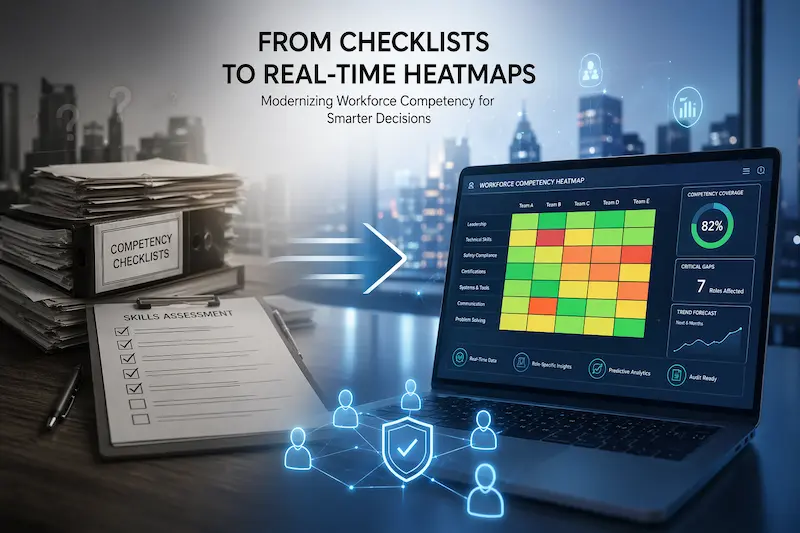
A traditional skills matrix is a static grid cells, checkmarks, dates. You have to know what you’re looking for to find anything useful. And if you’re managing hundreds or thousands of roles, the grid becomes noise.
Real-time heatmaps solve this differently. They surface patterns across the workforce automatically showing where competency coverage is strong, where it’s thinning, and where critical gaps are forming before they affect operations. A robust competency management system transforms traditional skill frameworks into dynamic, digital competency maps that visualize the complex relationships between competencies across the organization enabling identification of capability gaps and overlaps that simply weren’t visible in previous systems.
This kind of visualization changes the conversation in executive meetings. Instead of bringing a report that describes what happened last quarter, HR and operations leaders can bring a live view of where the workforce stands right now and what it will look like in six months if current trends continue.
Predictive capabilities now allow organizations to forecast critical capability gaps up to 18 months in advance, giving them time to develop internal talent rather than competing for increasingly scarce external hires with one enterprise reporting a 35% reduction in critical position vacancy duration as a result.
That’s the difference between reactive talent management and genuine workforce strategy.
Why is Enterprise Adoption Accelerating in 2026?
The demand for modern competency infrastructure isn’t coming from HR alone anymore. It’s coming from operations, compliance, finance, and the C-suite simultaneously and for different reasons.
Compliance pressure is intensifying. In regulated industries healthcare, energy, financial services, defense contracting demonstrating that workers are genuinely competent for specific tasks isn’t optional. Adopting competency management system software is no longer optional but necessary, as shifting workforce needs, regulatory requirements, and rapid industry changes demand agility that outdated systems cannot provide.
Skills-based hiring and development strategies are going mainstream. A 2025 State of Skills-Based Hiring report shows that 85% of employers now use some form of skills-based hiring, with 76% relying on skills tests to measure and verify candidate competency and organizations need infrastructure to carry those skills-based decisions through the entire employee lifecycle, not just at the point of hire.
The cost of getting it wrong is visible on the balance sheet. Without a clear view of workforce capabilities, compliance risks increase and workforce gaps go unnoticed and in industries where a single unqualified decision creates liability exposure, the cost of that blind spot is no longer theoretical.
What to Look for in a Workforce Competency Tracking Platform?
Not all platforms solve the same problem. Before evaluating tools, it’s worth being clear on what you actually need the system to do.
- Real-time visibility, not periodic reporting: The core value of modern platforms is live data. If a system still requires manual input cycles or batch updates, it’s adding automation to a broken process not replacing it.
- Role-specific competency mapping: Generic skills libraries don’t match how enterprises actually operate. The platform needs to allow organizations to define what competence means for specific roles, at specific sites, under specific regulatory requirements not just track whether a course was completed.
- Verified competency, not just training completion: Completion records tell you something happened. Competency verification tells you whether it worked. The strongest platforms connect training data to performance evidence, assessments, and supervisor sign-offs to produce a composite picture of actual capability.
- Integration with existing HR infrastructure: Most large enterprises have layered HR systems that have been built up over years. A competency platform that can’t pull from or feed into those systems creates another data silo which is exactly the problem it’s supposed to solve.
- Compliance-ready audit trails: In regulated industries, the audit-readiness of the platform is as important as the analytics. If generating a compliance report still requires manual data gathering, the system isn’t delivering full value.
Where iCAN Technologies Fits In?
For enterprises making this transition, the choice of platform matters as much as the decision to modernize.
iCAN Technologies is built specifically for the gap between where most enterprises are paper-based or spreadsheet-driven competency records and where they need to be. Rather than layering analytics on top of a traditional LMS, the platform starts from verified workforce competency as the foundational data layer.
Their workforce competency tracking platform maps skills and certifications to specific roles, tracks verified evidence of competency (not just course completion), and gives workforce planners a live view of where gaps exist and where they’re likely to emerge. For organizations in safety-critical or compliance-heavy environments, this distinction is operationally significant.
It’s the kind of system that turns a quarterly audit scramble into a routine check because the data is already current, already organized, and already mapped to the right framework.
The Shift Is Already Happening. The Question Is Where You Stand?
The enterprises moving fastest on this aren’t doing it because it’s fashionable. They’re doing it because the alternative is increasingly expensive.
Tracking employee skills in spreadsheets is a losing game organizations have skill gaps, and those gaps cost money in missed projects, bad hires, compliance failures, and people who quit because they can’t see a future.
Real-time competency visibility doesn’t eliminate those risks entirely. But it changes the timing. Instead of discovering a critical gap during an incident review or a failed audit, leaders see it forming and have a window to act.
That window is the practical value of modernization. Not the technology itself, but the lead time it creates.
Conclusion
The shift from checklists to real-time competency heatmaps isn’t a technology upgrade. It’s a change in what workforce management actually means for an enterprise.
Manual systems were built to satisfy compliance requirements after the fact. Modern platforms are built to support decisions before problems occur in hiring, development, deployment, and succession planning.
US enterprises that get ahead of this shift will have cleaner data, stronger compliance posture, faster response to talent gaps, and a workforce intelligence function that actually influences strategy. Those that wait will be playing catch-up in a talent environment that isn’t slowing down for anyone.
The tools to make this change exist. The data to justify it is clear. What remains is the decision to move.