
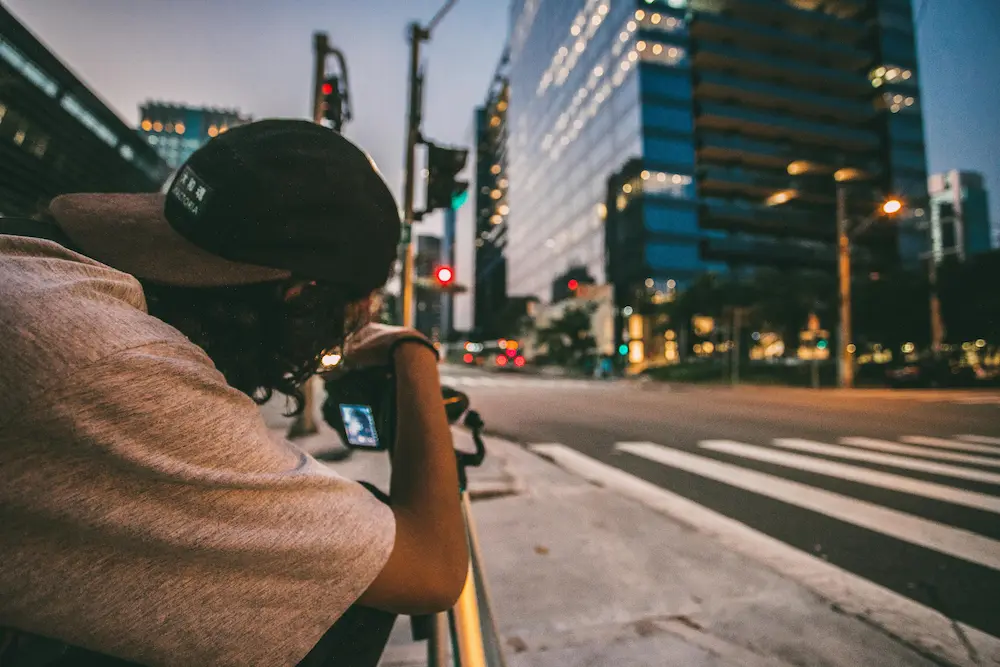
Every street scene carries movement. Cars advance through intersections, pedestrians weave past each other, and light shifts across buildings throughout the day. As a photographer, you step into that flow and try to make sense of it through your frame.
Motion alone doesn’t create a powerful image, as it also requires emotional weight to resonate. A technically sharp photo can still feel empty if it lacks human connection or context. Strong street photography captures both physical movement and inner tension or quiet emotion.
To do that, you must learn to observe carefully, because preparation begins with understanding how to read a scene before it fully unfolds.
Learning to Read the Street in Real Time
Develop the habit of anticipating actions as they unfold. Strong street images grow from watching patterns in public spaces. Notice how commuters move after a signal changes and where they slow down, pause, or turn.
These repeated behaviors help you plan your frame with intention. According to Nashville Film Institute, street photography centers on candid moments in public spaces that reflect daily life. It highlights the importance of blending into your environment and using natural light to preserve authenticity.
Simple gear and quiet observation allow you to document genuine human behavior without drawing attention to yourself. The source further explains that street photographers often work with compact setups to remain unobtrusive and ready to respond.
This approach shifts your focus from spectacle to subtle interaction and keeps you aligned with the scene’s natural flow. With this awareness, position yourself where movement approaches your frame. To achieve this, pre-focus on a zone and use a medium aperture to maintain sharp layers across the scene.
You can also frame doorways, crossings, and storefronts to guide the viewer’s eye effectively. As you begin to understand rhythm, your process becomes more deliberate and less reactive.
Capturing Fast Moments With Awareness
Fast shutter speeds can freeze a split second, yet freezing action alone does not create a meaningful photograph. You must also judge what deserves to be captured. In street spaces, scenes can change quickly, and a crowded junction may shift from clean motion lines to visible tension within seconds.
In these moments, ethics guide your response and shape your next decision. ExpertPhotography explains that shooting in public may be legal, yet you still balance creative freedom with a person’s right to privacy. It stresses asking permission in sensitive situations and respecting clear objections.
The source also advises you to examine your motive before sharing an image. With that in mind, you should always be aware of your surroundings. Viewfinder focus can narrow your field of vision and pull your attention away from moving traffic. High-traffic zones remain unpredictable, and vehicles do not slow for photographers.
If you cause or witness a serious incident, photography stops being the priority, as your focus shifts to safety and responsibility. After a roadside collision, legal and personal concerns may follow. Consulting a car crash lawyer helps you manage legal fallout and address injury or damaged equipment concerns.
According to TorHoerman Law, injured parties may pursue compensation when another’s negligence causes harm. Your judgment shapes not only what you capture but also how your images feel to others.
Why Some Street Photos Feel Emotionally Empty
You may notice that many street images look dramatic but feel empty. They often depend on intense lighting, heavy contrast, or staged-looking tension, which can overpower subtle emotion. This change developed gradually as digital shooting habits evolved.
DIYPhotography notes that classic street photographers worked with limited exposures and had to wait for meaningful moments. It explains that unlimited digital frames can reduce patience and weaken the intention behind each shot. The piece also questions whether constant shooting has replaced careful observation in modern practice.
This is why slowing down is essential. Stay in one location longer and observe how strangers interact over time. Notice how someone waits at a curb, checks a phone, or adjusts a bag while standing still. You can see this approach reflected in recent work. For example, 121Clicks presented its 2025 award-winning street selections as a curated set of 33 striking images.
The collection highlighted varied approaches, from layered crowd scenes to quiet, solitary figures framed by architecture. It also demonstrated how strong composition and timing, not spectacle, give ordinary street moments lasting impact.
When you maintain this focus, emotion develops naturally through patience and careful attention to everyday behavior.
When to Break the Rules in Street Photography
You don’t need rigid grids to shoot well. Street photography works best when you respond to the scene in front of you. It helps to understand how these rules developed over time.
The Phoblographer explains that the rule of thirds serves as guidance rather than a fixed law. It also notes that many familiar composition rules came from painting traditions. The piece adds that strong street images rely more on context and layered relationships than strict grid placement. It also references Garry Winogrand’s view that photography records fragments of time and space.
Keeping this in mind helps you stay flexible in your framing choices while remaining aware of the scene. PetaPixel also explores long-standing concerns within the genre. It highlights Susan Sontag’s idea that taking a photograph can resemble a symbolic act of possession.
The source discusses Bruce Gilden’s close flash technique and examines criticism of approaches that treat subjects as trophies. It contrasts this with a foraging mindset that values patience, openness, and shared presence. With this perspective, move through public spaces with awareness, give people room, and avoid cornering someone for dramatic effect.
Work in a way that keeps your presence visible and calm. Creative risk carries weight when your approach respects the people in your frame.
People Also Ask
1. Is it legal to take photos of strangers in public?
In many countries, taking photos in public spaces is legal because there is no “expectation of privacy.” However, using those images for commercial advertisements without a signed model release is a different story. Always check local privacy laws, as some regions have much stricter rules regarding individual image rights.
2. How do I overcome the fear of shooting street photography?
Start by “fishing,” i.e., pick a great background and let the subjects walk into your frame. This feels less intrusive than chasing people. You can also try shooting from the hip or using a tilt-shift screen. Remember, a friendly smile or a polite nod usually de escalates any potential tension instantly.
3. Do I need a professional camera for street photography?
You can start with a smartphone or a basic point and shoot camera. Many award winning photographers prefer smaller gear because it looks less intimidating to strangers. The key is your ability to see a story unfolding; the “best” camera is simply the one you have ready in your hand.
Motion is visible everywhere on the street, but emotion requires deeper attention. You must watch, wait, and judge each situation with care.
Anticipation helps you prepare, ethics guide your choices, and patience deepens your images. When you balance technique with awareness, your photographs gain weight. They reflect real life, not staged drama.
Street photography is not about chasing chaos. It is about understanding people in motion and honoring the moments you choose to keep.